

|
(alphabetized) |
 Gardening
Gardening
Edible Fruits for the Adventurous Gardener
by Dr. William M. Johnson, Galveston County Extension Agent - Horticulture
January 25, 2006
 Edible
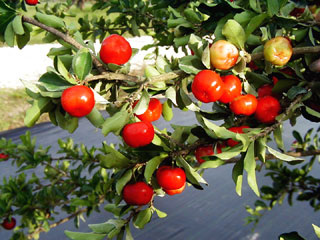
Barbados Cherry is an attractive landscape shrub or tree and also produces
multiple crops of edible fruits high in vitamin C. Master Gardeners will
offer three varieties of Edible Barbados Cherry as well as a wide selection
of other fruit trees at their February 4 plant sale. Photo
Credit: Heidi Sheesley
Edible
Barbados Cherry is an attractive landscape shrub or tree and also produces
multiple crops of edible fruits high in vitamin C. Master Gardeners will
offer three varieties of Edible Barbados Cherry as well as a wide selection
of other fruit trees at their February 4 plant sale. Photo
Credit: Heidi Sheesley
Whether you plan to add to your existing collection of fruit trees in the landscape or you are just starting out, be sure to make a notation on your gardening calendar to attend the Galveston County Master Gardeners Fruit Tree Seminar & Sale on Saturday, February 4, 2006. There will be an offering of the “normal stuff” such as a wide assortment of apples, citrus, Asian and European pears, plums, peaches, figs, grapes, blackberries, and pecans.
Upcoming ProgramsMaster Gardeners Fruit Tree Sale & Seminar: Saturday, February 4, Carbide Park’s Wayne Johnson Community Center, 4102 FM 519 in La Marque. - Seminar begins at 8:00 a.m. with speaker Heidi Sheesley of TreeSearch Farms. - Sale begins at 9:00 a.m. and continues until 1:00 p.m. with many varieties of fruit trees and citrus. Open to the general
public. No reservation required. Refer to the website address provided
below for more details.
|
There will also be a selection of fruit trees for the adventurous. Some gardeners will be delighted by some very different, hard-to-find-them-anywhere fruits that may do well in our yards. For example, Mexican Avocados and Edible Barbados Cherry offer their own distinctive flavors and textures and merit consideration.
Mexican Avocados
Mexican Avocados are a highlight in this year Master Gardener’s plant sale. There are three distinct horticultural races of avocado (West Indian, Guatemalan and Mexican) plus hybrids between them. Mexican Avocados are the most cold tolerant of the three.
Mexican Avocados offered at the plant sale are grafted and will sustain temperature drops to at least 15 degrees F two years after planting since cold-hardiness increases as the tree matures.
Mexican Avocado fruit ripens in the summer and has good flavor. The fruit is rarely larger than 8 to 12 ounces, is green to purple or black, and has very thin skin. The crushed leaves of Mexican Avocados have a distinct odor of anise (licorice), which is lacking in the other races of avocado.
Avocado trees are adapted to most soil types found in our growing region, provided the soil has good internal drainage. The tree will not perform well in poorly drained soils, nor will it tolerate flooding. The planting site should be chosen with cold protection in mind, especially during the first two years’ of growth. Generally, the south or southeast side of the house is the warmest location in a residential site. Because it can become a large tree, it should be planted no closer than 8 to 10 feet from the house.
Trees generally mature to 20-25 feet in our area, and no training is required. Avocados flower at an early age, and you may pick a couple of fruit by the second year. Blooms appear January-February, and the fruit begins to ripen in September, depending on the variety. Harvest avocados before they're too soft, and allow to further soften indoors.
Grafted varieties will produce a few fruit two years after establishment (which is defined as the tree having made significant growth after planting). Mature trees can produce two to three or more bushels of avocados with good management, depending upon variety. If you’re waiting on that grocery-store seedling, be aware that avocados do not come true from seed and seedlings may take up to 10 to 15 years to fruit.
Edible Barbados Cherry
Another temptation for the adventurous gardeners is the Edible Barbados Cherry. Unlike the ornamental Barbados Cherry with small red berries edible by birds, this Barbados Cherry is larger and edible by humans. It is still an ornamental bush and doubles as a source of wonderful fruit to eat.
Edible Barbados Cherry is a 15- to 18-foot plant with early-spring pink flowers followed by sweetly tart 3/4 -inch red fruit high in vitamin C. Heidi Sheesley of Treesearch Farms says this small tree, like the avocado, needs winter protection during the juvenile stage.
The fruit of Edible Barbados Cherry can be used in many ways. It can be eaten fresh and is excellent for juice, by itself or in a mixture
The cooked fruits must be strained to remove the seeds and the resulting sauce or puree can be utilized as a topping on cake, pudding, ice cream or sliced bananas, or used in other culinary products. The fresh juice will prevent darkening of bananas sliced for fruit cups or salads.
The fruit can also be used for gelatin desserts, punch or sherbet, and has been added as an ascorbic acid supplement to other fruit juices. The fruits may be made into syrup or, with added pectin, excellent jelly, jam, and other preserves.
The soft, juicy, thin-skinned fruits are light to deep crimson when mature. The flesh is yellow-orange. They average about an inch in diameter but vary from one-half to more than an inch.
The fruit is also widely used in the health food industry as a natural source of vitamin C. Vitamin C content ranges from 1000 to 2000 mg per 100 gm in the edible portion of fully ripe fruit and may be as high as 4500 mg per 100 gm in partially ripe fruit. A single fruit of some selections could supply the daily adult requirement of vitamin C.
The tree may have 3 to 5 crops per year, May to November, with the largest crops during the summer. However, this can vary with weather conditions. In addition to the value of its fruit, Edible Barbados Cherry is an attractive shrub or tree which can be used for its ornamental value in landscaping.
Dr. Johnson is a horticulturist with the Galveston County
Extension Office of Texas Cooperative Extension, Texas A&M University.
Visit his web site at http://aggie-horticulture.tamu.edu/galveston/index.htm
Gardening: Scale insects and pampas grass - July 17, 2004 article
Gardening: Bananas - August 1, 2004 article
Gardening: August Gardening Calendar - August 16, 2004 article
Gardening: Prepare Now For Fall Gardens - August 26, 2004 article
Gardening: September's Garden Calendar Includes Fall Pecan Field Day - September 2, 2004 article
Gardening: Ornamental Grasses - September 8, 2004 article
Gardening: Don't Let Landscape Become A High-Maintenance Nightmare - September 22, 2004 article
Gardening: Rose Propagation & Seasonal Decorating Workshops To Be Held - October 13, 2004 article
Gardening: November Is Pansy Time - November 6, 2004 article
Gardening: County Pecan Growers Display Their Successes - November 11, 2004 article
Gardening: Gardeners' Questions On Fall Crops - November 17, 2004 article
Gardening: Gardeners' Q&As For November - November 28, 2004 article
Gardening: Gardeners' December Checklist Includes Citrus Show On Dec. 9 - December 3, 2004 article
Gardening: Citrus Show A Huge Success With 185 Entries - December 19, 2004 article
Gardening: Trees and Shrubs - December 23, 2004 article
Gardening: Cold Weather Impact - January 4, 2005 article
Gardening:Announcing the 2005 Galveston County Master Gardener Training - January 13, 2005 article
Gardening:Peach & Plum Growers' Workshop To Be Held Saturday, January 29 - January 19, 2005 article
Gardening: Gardening for Texas Wildlife - January 28, 2005 article
Gardening: Extension Activities At The Home & Garden Show On Feb. 26-27 - February 23, 2005 article
Gardening: March Gardening Calendar Includes Seminar On Butterfly Gardening - March 2, 2005 article
Gardening: Gardeners' Q&As From The Galveston Home & Garden Show - March 10, 2005 article
Gardening: Program On Plumeria Offered On March 26- March 29, 2005 article
Gardening: Garden Checklist For April Includes Pecan Field Day - April 6, 2005 article
Gardening: Hints On Harvesting Vegetables For Peak Flavor - April 15, 2005 article
Gardening: Learn About Weed Control - April 27, 2005 article
Gardening: Home Gardening Chores and
May 14 Home Fruit Growers’ Tour - May 5, 2005 article
© 2004-2006
League City Area News Online.
All rights reserved.
Marilyn Clark.
League City Area News Online, P. O. Box 1693, League City, Texas 77574-1693
Please include your address and phone number for verification purposes.