

|
(alphabetized) |
 Gardening
Gardening
Fruit Tree Q&As
by Dr. William M. Johnson, Galveston County Extension Agent - Horticulture
February 15, 2006
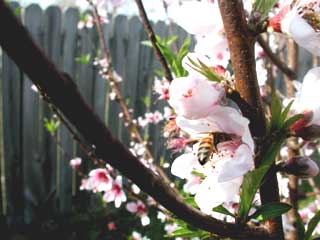
The unusually warm weather during January stimulated many peach trees and other types of fruit trees to set blooms earlier than usual. Photo Credit: William M. Johnson
Upcoming Gardening SeminarsSaturday, February 18: "Growing Hybrid Tea Roses Seminar" by Master Gardener Jon Johns, 9-11:30 a.m. Saturday, March 4: "A Garden for Butterflies Seminar" by Master Gardener Anna Wygrys, 9-11 a.m. All seminars will be held at the Galveston County Extension Office located at 5115 Highway 3 in Dickinson. No fee but pre-registration is required (281-534-3413 Ext. 6, or GALV3@wt.net). Visit website listed below for more information. |
Question: My peach tree started blooming in early January. Why did it bloom so early this time?
Answer: Most hardy fruit trees need a certain amount of cool winter weather to end their dormancy and to promote spring growth. Peach trees need the cool weather during the winter in order for the buds to develop properly, so the tree will bloom and leaf out normally. Weather conditions can dramatically speed or delay the onset of blooming. The number of cool temperature hours needed is known as the chill hour requirement. The lower a tree’s chill hour requirement, the more likely it will set blooms early when extended periods of warm weather conditions occur. More information on chill hours is provided in the following question.
Basically, your peach tree had received sufficient cold to be able to bloom. Since temperatures were unusually warm during January, your peach tree "decided" that spring was here and it’s time to bloom. Don’t get too upset with your peach tree as lots of other peach trees across the county came to the same conclusion and have been blooming a bit earlier than normal.
Question: What does the term
"chill hour requirement" mean?
Answer: In order to set fruit, most trees require exposure to a minimum number of hours of temperatures within the range of 32 to 45 Fahrenheit. This temperature range is called "chill hour requirement" and the amount can vary widely for varieties within a given fruit class. The local growing area has a range of 500 chill hours to less than 200 chill hours over a winter season. If an advertisement claims a fruit tree is hardy to zero for a zillion hours, then don't expect a lot of fruit if you grow it locally! Look for a variety that says it needs "low chill hours" or 400 chill hours or less.
Question: Will fruit trees do well if grown in containers?
Answer: Yes, many types of fruit and citrus trees will do well in containers if adequate care is provided. It is important that a large enough container be used–at least a 15-gallon size container should be used for most dwarf-type trees while up to 30-gallon containers should be used for larger size trees.
Be aware that fruit and citrus trees grown in containers must be watered often and throughout the year including the winter season. A slow release fertilizer should be applied in the spring and a liquid fertilizer containing minor elements should be applied every 2 to 4 weeks during the active growing season. Another benefit of growing in containers is that plants may be brought inside a garage in the event of cold weather in early spring.
Question: What is the difference between bare-rooted and container-grown fruit trees?
Answer: Container-grown fruit trees are grown in a pot and are well rooted. Bare-rooted trees have been grown in the ground at a nursery and then dug, wrapped and shipped without soil on the roots. Bare-rooted trees are less expensive than container-grown trees but they are easy to plant and grow vigorously. Once you have selected the best possible tree, you must transfer that bare-rooted tree into the soil. This one step in fruit production may result in rapid success, lingering existence or sudden death.
Since most fruit trees are sold either bare-rooted or "packaged bare-root," planting techniques will be the same for all varieties. Plant the tree as soon as possible. If there is any delay, store the tree in a cool, shady location. And most important, keep the roots moist (but not soaked) during this time. Five minutes without moisture may spell disaster.
Question: What is the most important factor in growing fruit trees?
Answer: The one simple and most critical factor when investing in home fruit production is variety selection. While there are several other important factors involved, without the proper variety, you may be up the proverbial creek without a paddle–or, in the case at point, without a fruit to eat.
Homeowners waste thousands of dollars each year on fruit varieties which are not adapted to their growing area. These undesirable varieties may lack disease resistance, proper chilling requirements, etc. In many cases, the newer varieties are simply superior in production and quality. There are literally hundreds of varieties of each kind of fruit and at least three-fourths of them are not adapted to Texas.
Question: Must I always plant two fruit trees for pollination?
Answer: If the landscape has a space limitation for only one tree, pollination can become a problem for some types of fruits. Unless you can persuade the next door neighbor to plant a "friend" for your tree, a self-pollinator will be your best choice. However, many popular fruits are self-pollinating or have some self-pollinating varieties. Occasionally, trees are double-grafted with a pollinator. Peaches, nectarines, apricots, blackberries, raspberries, and citrus are all self-fruitful. Most other fruit will produce better if planted with a different variety that blooms at the same time.
Dr. Johnson is a horticulturist with the Galveston County
Extension Office of Texas Cooperative Extension, Texas A&M University.
Visit his web site at http://aggie-horticulture.tamu.edu/galveston/index.htm
Gardening: Scale insects and pampas grass - July 17, 2004 article
Gardening: Bananas - August 1, 2004 article
Gardening: August Gardening Calendar - August 16, 2004 article
Gardening: Prepare Now For Fall Gardens - August 26, 2004 article
Gardening: September's Garden Calendar Includes Fall Pecan Field Day - September 2, 2004 article
Gardening: Ornamental Grasses - September 8, 2004 article
Gardening: Don't Let Landscape Become A High-Maintenance Nightmare - September 22, 2004 article
Gardening: Rose Propagation & Seasonal Decorating Workshops To Be Held - October 13, 2004 article
Gardening: November Is Pansy Time - November 6, 2004 article
Gardening: County Pecan Growers Display Their Successes - November 11, 2004 article
Gardening: Gardeners' Questions On Fall Crops - November 17, 2004 article
Gardening: Gardeners' Q&As For November - November 28, 2004 article
Gardening: Gardeners' December Checklist Includes Citrus Show On Dec. 9 - December 3, 2004 article
Gardening: Citrus Show A Huge Success With 185 Entries - December 19, 2004 article
Gardening: Trees and Shrubs - December 23, 2004 article
Gardening: Cold Weather Impact - January 4, 2005 article
Gardening:Announcing the 2005 Galveston County Master Gardener Training - January 13, 2005 article
Gardening:Peach & Plum Growers' Workshop To Be Held Saturday, January 29 - January 19, 2005 article
Gardening: Gardening for Texas Wildlife - January 28, 2005 article
Gardening: Extension Activities At The Home & Garden Show On Feb. 26-27 - February 23, 2005 article
Gardening: March Gardening Calendar Includes Seminar On Butterfly Gardening - March 2, 2005 article
Gardening: Gardeners' Q&As From The Galveston Home & Garden Show - March 10, 2005 article
Gardening: Program On Plumeria Offered On March 26- March 29, 2005 article
Gardening: Garden Checklist For April Includes Pecan Field Day - April 6, 2005 article
Gardening: Hints On Harvesting Vegetables For Peak Flavor - April 15, 2005 article
Gardening: Learn About Weed Control - April 27, 2005 article
Gardening: Home Gardening Chores and
May 14 Home Fruit Growers’ Tour - May 5, 2005 article
© 2004-2006
League City Area News Online.
All rights reserved.
Marilyn Clark.
League City Area News Online, P. O. Box 1693, League City, Texas 77574-1693
Please include your address and phone number for verification purposes.