

|
(alphabetized) |
 Gardening
Gardening
Crape Murder" & Other Gardeners’ Dilemmas
by Dr. William M. Johnson, Galveston County Extension Agent - Horticulture
February 22, 2006
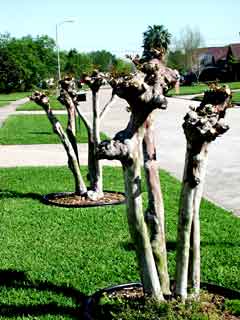
Excessive pruning of crape myrtles typically results in weakly-attached, spindly branches. Excessive pruning is not a healthy procedure for any landscape tree. Horticulturists sometimes refer to this assault on the crape myrtle as "crape murder." Photo Credit: William M. Johnson
Question: My neighbor and many other folks are pruning their crape myrtles now. Is this a good practice?
Upcoming Gardening SeminarsSaturday, March 4: "A Garden for Butterflies Seminar" by Master Gardener Anna Wygrys, 9-11 a.m. All seminars will be held at the Galveston County Extension Office located at 5115 Highway 3 in Dickinson. No fee but pre-registration is required (281-534-3413 Ext. 6, or GALV3@wt.net). Visit website listed below for more information. |
Answer: It’s almost an annual ritual during this time of year in Texas to "top" crape myrtles, and yes, crape myrtles are very hardy landscape trees even under such management practices.
However, severe topping is not a healthy procedure for any landscape tree. Topping causes numerous sprouts of new growth that are weakly attached to the trunk. These weakly-attached branches are thin and spindly and will droop when wet by a rainstorm and/or when flower production is heavy. Moreover, after repeated episodes of pruning back to the same area of the trunk, the pruning site often develops unsightly, knotty growths.
Horticulturists sometimes refer to this assault on the crape myrtle as "crape murder." To correct the problem, remove all but one or two of the new branches on a main trunk. Select the strongest upright branch as the new leader and cut off the others so energy produced by the plant will be concentrated in the new leader rather than divided among four, five or even a dozen new branches. Select a second branch and cut it back to an outward facing bud.
Finally, next year do NOT top the crape myrtle regardless what you see your neighbors or professional pruners do. We can excuse the neighbor for not knowing but the professional pruner should know better.
If you plan to include, or to replace, crape myrtles as part of a new landscape but space is a limiting factor, consider selecting a dwarf variety. You would not be tempted to perform the ritual of "topping" and your crape myrtles would provide a pleasing design as well as color to the landscape.
Question: I am new to this area and plan to start a garden. The soil is a heavy clay. What would you consider to be the most important step in improving this stuff?
Answer: Welcome to the club. The most common soil type in the area is clay–it's affectionately called gumbo clay. Some gardeners call it 12-inch clay–if you take 12 steps in it, you're likely to have 12 inches of soil adhering to each foot!
Yes, it's tough, but certainly not impossible, to work with. Without a doubt, the addition of organic matter would be the most important thing a gardener can do to improve gumbo. Organic matter worked into the gumbo clay improves soil texture and thus makes the soil easier to work; supplies many needed plant nutrients; improves the conditions for the development of beneficial organisms such as earthworms; slows leaching of nutrients by providing a holding system; and speeds excess water movement and drainage through the soil.
I have seen numerous gardeners who started out with tough gumbo and over time achieve a very workable and fertile soil. However, you must add organic matter on regular basis to achieve the same end results. Lawn clippings, leaves, manure and shredded pine bark are excellent sources of organic matter. You should also consider starting a compost to efficiently recycle your garden and landscape waste.
Question: In designing my vegetable garden, should the rows run east and west or north and south or does it really make a difference?
Answer: The direction of garden rows should be determined by two important factors. One is the slope of the land. Obviously, most garden sites here are fairly level. If your garden site is located on a relatively steep slope, rows should generally run across the slope to reduce soil washing and erosion.
On the other hand, if the site has a very mild slope to it, running the rows parallel to the slope can provide some drainage during our wet springs. The other determining factor is the type of vegetables to be grown.
If you include tall growing vegetables in your garden, such as sweet corn and staked tomatoes, beans, and cucumbers, be sure to locate them on the north side of either east-west rows or north-south rows. Otherwise, such tall growing crops will shade lower growing vegetables.
Question: With all this warm weather my grass has begun to grow again. Can I go ahead and fertilize my St. Augustine lawn now using a slow release fertilizer?
Answer: The mild weather we have been experiencing has even caused some trees to bud out two to three weeks earlier than normal. It can be very tempting to begin projects such as fertilizing much earlier than recommended.
Some homeowners started fertilizing their lawns in January which is not recommended as lawn grass will make poor utilization of the nitrogen at that time of the year. Fertilizing the lawn should be postponed until the plant can make better use of the fertilizer (generally around mid-March to early April). Also, slow release fertilizers are not quite as effective in the winter months.
Question: I live in Galveston and have to deal with very sandy soil. Would adding organic matter to sandy soil be of any benefit?
Answer: Organic matter worked into the garden soil will help improve the soil texture, and increase the water holding capacity of sandy soils. As with clay soils, organic matter also supplies many needed plant nutrients and improves the condition for the development of beneficial organisms such as earthworms and slows leaching of valuable nutrients.
Dr. Johnson is a horticulturist with the Galveston County
Extension Office of Texas Cooperative Extension, Texas A&M University.
Visit his web site at http://aggie-horticulture.tamu.edu/galveston/index.htm
Gardening: Scale insects and pampas grass - July 17, 2004 article
Gardening: Bananas - August 1, 2004 article
Gardening: August Gardening Calendar - August 16, 2004 article
Gardening: Prepare Now For Fall Gardens - August 26, 2004 article
Gardening: September's Garden Calendar Includes Fall Pecan Field Day - September 2, 2004 article
Gardening: Ornamental Grasses - September 8, 2004 article
Gardening: Don't Let Landscape Become A High-Maintenance Nightmare - September 22, 2004 article
Gardening: Rose Propagation & Seasonal Decorating Workshops To Be Held - October 13, 2004 article
Gardening: November Is Pansy Time - November 6, 2004 article
Gardening: County Pecan Growers Display Their Successes - November 11, 2004 article
Gardening: Gardeners' Questions On Fall Crops - November 17, 2004 article
Gardening: Gardeners' Q&As For November - November 28, 2004 article
Gardening: Gardeners' December Checklist Includes Citrus Show On Dec. 9 - December 3, 2004 article
Gardening: Citrus Show A Huge Success With 185 Entries - December 19, 2004 article
Gardening: Trees and Shrubs - December 23, 2004 article
Gardening: Cold Weather Impact - January 4, 2005 article
Gardening:Announcing the 2005 Galveston County Master Gardener Training - January 13, 2005 article
Gardening:Peach & Plum Growers' Workshop To Be Held Saturday, January 29 - January 19, 2005 article
Gardening: Gardening for Texas Wildlife - January 28, 2005 article
Gardening: Extension Activities At The Home & Garden Show On Feb. 26-27 - February 23, 2005 article
Gardening: March Gardening Calendar Includes Seminar On Butterfly Gardening - March 2, 2005 article
Gardening: Gardeners' Q&As From The Galveston Home & Garden Show - March 10, 2005 article
Gardening: Program On Plumeria Offered On March 26- March 29, 2005 article
Gardening: Garden Checklist For April Includes Pecan Field Day - April 6, 2005 article
Gardening: Hints On Harvesting Vegetables For Peak Flavor - April 15, 2005 article
Gardening: Learn About Weed Control - April 27, 2005 article
Gardening: Home Gardening Chores and
May 14 Home Fruit Growers’ Tour - May 5, 2005 article
© 2004-2006
League City Area News Online.
All rights reserved.
Marilyn Clark.
League City Area News Online, P. O. Box 1693, League City, Texas 77574-1693
Please include your address and phone number for verification purposes.