

|
(alphabetized) |
 Gardening
Gardening
Papayas provide striking accent to the landscape and are easy to grow
by Dr. William M. Johnson, Galveston County Extension Agent - Horticulture
March 29, 2006
 The
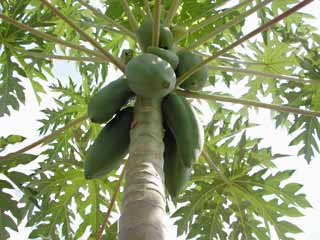
papaya is a versatile plant may just be the showstopper your garden needs
while providing fresh tropical fruit for family and friends. Try a single
plant or a cluster of plants in your landscape and see how many heads turn
to admire your garden. Photo
Credit: William M. Johnson
The
papaya is a versatile plant may just be the showstopper your garden needs
while providing fresh tropical fruit for family and friends. Try a single
plant or a cluster of plants in your landscape and see how many heads turn
to admire your garden. Photo
Credit: William M. Johnson
Papayas are one of the most amazing fruits that home gardeners can try. These breathtaking trees have single trunks up to 20-30 feet tall that constantly turn heads. Papayas can provide a soft, tropical accent to the home landscape. What's even more amazing is that they are one of the easiest tropical fruits to grow.
Many Gulf Coast gardeners have realized that these trees make wonderful additions to the home landscape for their tropical appearance and abundant fruit. The large, deeply lobed leaves also add contrast as they tower above other traditional landscape features.
The leaves are large (up to 3 feet in diameter) and deeply lobed, borne on hollow petioles up to 2 feet in length. The older leaves abscise or drop as new leaves emerge, producing a palm-like form to the plant. The flowers and fruit arise from buds on the trunk at the base of the leaves.
The papaya is native to Central America and is grown in tropical and subtropical areas worldwide. Consequently, papayas thrive in warm, humid conditions—a perfect match for our growing environment. However, they generally are intolerant of high winds, so they need to be planted in a protected area.
Papayas also need full sun to thrive and plants should be spaced 8 to 10 feet apart. A southern or southeasterly exposure is preferred. Such exposures generally will also provide some protection in the winter as very cool weather conditions will kill young plants.
Well-established papayas will require some protection during the winter season when temperatures drop to the mid-forties or lower. Because papayas rapidly reach 10 to 15 feet or more, cold protection of the top is difficult. Protection of the lower portion of the trunk topically permits the plant to regrow from sprouts in the event of freeze damage.
Papayas are tolerant of many soil types, but good drainage is essential. Its shallow root system will not tolerate excessive or standing water. Raised beds may be an option if drainage problems plague your yard.
Weed and grass control within 4 feet of papaya trees is essential for optimal growth and fruiting. Cultivating or hoeing soil around the root system should be done with care. Hand pulling and heavy mulching with organic bark mulch are better options for weed control.
Be aware that papayas are heavy feeders and need to be fertilized monthly with about 4 ounces of ammonium sulfate (21-0-0) on a monthly basis during the first season of active growth. During the following year, fertilizer amounts can be doubled between March and early October. Excessive fertilizer during the fall and winter months may produce succulent growth that is more susceptible to freezing temperatures.
Viral diseases are common in papayas and are uncontrollable. Distorted or yellow-mottled leaves are a telltale sign. So is stunted growth along with poor fruit set and yellow rings on fruit and leaves. Infected plants should be removed and destroyed.
Papayas are relatively pest free. Whiteflies might pose a problem from time to time, leading to the presence of black, sooty mold on the leaves and fruit. Insecticidal soaps are the best means of control because of the fruit-bearing potential of these plants.
Most papayas require up to 18 months to 2 years to produce fruit from the seedling stage. The papaya plant may produce male or female flowers or a combination of both flower types.
Although locating a nursery that sales papaya can require time and effort, it is best to purchase papayas as container grown plants. However, seed can be obtained from papaya fruit purchased at the local supermarket. If the fruit is from Hawaii, the chances are good that the resulting seedlings will be mostly bisexual.
Well-tended papayas can yield 100 to 200 pounds of fruit per year. You can pick fruit as soon as it develops a yellow tinge at the tip. Or you can wait for better quality by allowing the fruit to remain on the plant until completely yellow and ripe.
Papayas are low in calories and rich in natural vitamins and minerals, particularly in vitamins A & C, and potassium. One cup of fresh cubes (approximately 100 grams by weight) of papaya contains: 55 calories, 0.61 gm protein, 9.8 gm carbohydrates, 1.8 gm dietary fiber, 89% water, 283 IU vitamin A, 62 mg vitamin C, 38 mg folate and 257 mg potassium.
The most common use of papaya is fresh, in slices or chunks and in fruit compotes. A thick juice can be prepared by blending diced papaya with a little water. Papaya can also be sliced and dried. Green papaya is sometimes cooked and eaten like squash.
Papaya is a prime source of papain enzyme (used as a meat tenderizer), so green fruit chunks and leaves can be wrapped around meat or fowl before cooking to enhance tenderness and flavor.
This versatile plant may just be the showstopper your garden needs while providing fresh tropical fruit for family and friends. Try one and see how many heads turn to admire your garden.
Dr. Johnson is a horticulturist with the Galveston County
Extension Office of Texas Cooperative Extension, Texas A&M University.
Visit his web site at http://aggie-horticulture.tamu.edu/galveston/index.htm
Gardening: Scale insects and pampas grass - July 17, 2004 article
Gardening: Bananas - August 1, 2004 article
Gardening: August Gardening Calendar - August 16, 2004 article
Gardening: Prepare Now For Fall Gardens - August 26, 2004 article
Gardening: September's Garden Calendar Includes Fall Pecan Field Day - September 2, 2004 article
Gardening: Ornamental Grasses - September 8, 2004 article
Gardening: Don't Let Landscape Become A High-Maintenance Nightmare - September 22, 2004 article
Gardening: Rose Propagation & Seasonal Decorating Workshops To Be Held - October 13, 2004 article
Gardening: November Is Pansy Time - November 6, 2004 article
Gardening: County Pecan Growers Display Their Successes - November 11, 2004 article
Gardening: Gardeners' Questions On Fall Crops - November 17, 2004 article
Gardening: Gardeners' Q&As For November - November 28, 2004 article
Gardening: Gardeners' December Checklist Includes Citrus Show On Dec. 9 - December 3, 2004 article
Gardening: Citrus Show A Huge Success With 185 Entries - December 19, 2004 article
Gardening: Trees and Shrubs - December 23, 2004 article
Gardening: Cold Weather Impact - January 4, 2005 article
Gardening:Announcing the 2005 Galveston County Master Gardener Training - January 13, 2005 article
Gardening:Peach & Plum Growers' Workshop To Be Held Saturday, January 29 - January 19, 2005 article
Gardening: Gardening for Texas Wildlife - January 28, 2005 article
Gardening: Extension Activities At The Home & Garden Show On Feb. 26-27 - February 23, 2005 article
Gardening: March Gardening Calendar Includes Seminar On Butterfly Gardening - March 2, 2005 article
Gardening: Gardeners' Q&As From The Galveston Home & Garden Show - March 10, 2005 article
Gardening: Program On Plumeria Offered On March 26- March 29, 2005 article
Gardening: Garden Checklist For April Includes Pecan Field Day - April 6, 2005 article
Gardening: Hints On Harvesting Vegetables For Peak Flavor - April 15, 2005 article
Gardening: Learn About Weed Control - April 27, 2005 article
Gardening: Home Gardening Chores and
May 14 Home Fruit Growers’ Tour - May 5, 2005 article
© 2004-2006
League City Area News Online.
All rights reserved.
Marilyn Clark.
League City Area News Online, P. O. Box 1693, League City, Texas 77574-1693
Please include your address and phone number for verification purposes.