

|
(alphabetized) |
 Gardening
Gardening
Garden checklist for April includes Pecan Field Day
by Dr. William M. Johnson, Galveston County Extension Agent - Horticulture
April 5, 2006
 Jim
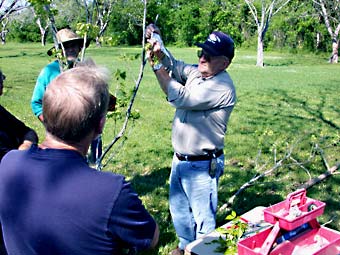
Hall of Santa Fe demonstrates the basics of the four-flap or banana graft on
pecans. He and other members of the Extension Fruit & Pecan Committee will
be on hand to provide ongoing demonstrations at the Pecan Grafting Workshop
from 4:00-5:30 p.m. on Wednesday, April 12, at Carbide Park in La Marque. Photo
credit: Herman Auer
Jim
Hall of Santa Fe demonstrates the basics of the four-flap or banana graft on
pecans. He and other members of the Extension Fruit & Pecan Committee will
be on hand to provide ongoing demonstrations at the Pecan Grafting Workshop
from 4:00-5:30 p.m. on Wednesday, April 12, at Carbide Park in La Marque. Photo
credit: Herman Auer
Weather conditions during the month of March were not overly kind to spring vegetable gardeners. Last month's weather has been remarkably dry. Rainfall amounts across the county were 3-6 inches below average before the welcome rains during the last days of the month. The month of March was also rather windy and downright cool. Some gardeners have put in a second and even a third crop of tomatoes and peppers.
However, April is a wonderful time to enjoy gardening. Add the pleasant temperatures and you have a strong invitation to get out in the garden. Here's a checklist for keeping up with the chores while enjoying the pleasures of April.
SPRING PECAN FIELD DAY:
The Spring Pecan Field Day will be conducted on Wednesday, April 12, from 4:00 p.m. to 5:30 p.m. Grafting demonstrations will be provided throughout the time period by members of the Extension Fruit and Pecan Committee. Graftwood from several varieties of pecans will be available (a donation of $1.00 per stick is requested). Graftwood of several fruit trees will also be available.
The Field Day will be held in La Marque in the Pecan Orchard at the Carbide Park (which is located on the North side of FM 519 about one mile West of the intersection of FM 519 and the I-45 Gulf Freeway, Exit #10). A printable map can be downloaded from the web site address at the end of this column (click on "Extension Educational Programs" link) or contact the Galveston County Extension Office for additional information (281-534-3413, ext. 6 or GALV3@wt.net).
SUMMER ANNUALS:
One tendency shoppers have is to buy transplants of summer annuals only with open flowers. Young transplants that have few or no flowers may be a smarter purchase since these plants will grow larger before flowering. The result will be a more impressive floral display in your home gardener.
PERIWINKLES: One warm season annual that many folks set out too early is periwinkle. These are warm weather plants. Periwinkles planted before mid-April are much more susceptible to a fungal blight disease that can wipe out a whole bed of plants. Delay planting periwinkles until the weather is consistently warm.
CALADIUMS: Select caladium tubers while there are ample stocks available but do not plant caladiums too early. They typically should be planted from April into early May. Caladiums need warm soil temperatures (at least 70 degrees) for best growth.
AZALEAS:
Wait to fertilize azaleas until after the major bloom season is finished. Consider using a fertilizer specially formulated for azaleas which provides plant nutrients in the right ratio and also helps to maintain acid soil conditions needed by azaleas. Because azaleas have a shallow root system, many gardeners have found it to be beneficial to apply several light fertilizer applications over time rather than all at one time.
LAWN MOWERS:
Periodically check your lawn mower blade for dullness and examine a few blades of freshly mowed grass. Use of a dull blade will result in the mowed (better descriptions would be torn and "whacked-off") end of leaf blades and stems being stringy and ragged. These tips will also develop a brownish discoloration shortly after being mowed. In addition to looking unsightly and causing the mower engine to labor harder, lawn grass cut with a dull blade is more susceptible to certain diseases.
FERTILIZING LAWNS:
Mid-March to the first week of April is the recommended time to fertilize lawns. A good way to determine when to fertilize is to wait until you have mowed the predominant lawn grass twice. If you fertilize too early, you will be fertilizing the winter weeds! This allows time for the grass to green up naturally without pushing it into growth.
This practice results in a turf that is more resistant to summer stress. Use a 3-1-2 ratio fertilizer (such as 15-5-10) and distribute with a broadcast (cyclone) or a drop-type spreader. Uniform distribution is essential to prevent light and dark streaks in the lawn. For better distribution, divide the fertilizer into two equal applications. Spread one application lengthwise and the other crosswise.
"WEED AND FEED" FERTILIZERS:
Use caution when applying the popular "weed and feed" type lawn fertilizers. Some weed and feed products can be used near shrubs and inside the drip line area of trees while other types of weed and feed products carry a strict warning to not apply the product near such landscape plants. It depends on the type of weed killer (or combination of weed killers) that is contained in a given product. Be sure to carefully read the label and never exceed the rate stated on the label.
BEDDING PLANTS:
Pinch back leggy bedding plants to encourage side shoots. Pinching stops the terminal growth, thus resulting in bushier plants and more flower buds.
PURCHASING TOPSOIL:
Use good quality topsoil from a reputable source for raising flower beds, filling low spots in the lawn, etc. Nutgrass and other hard-to-kill weeds are sometimes introduced this way.
LEAF DROP ON EVERGREENS:
Don't be concerned about the old leaves on magnolia, photinia, gardenia, ligustrum, and pittosporum turning yellow and falling. This is a natural occurrence this time of the year as new growth and foliage develop.
Dr. Johnson is a horticulturist with the Galveston County
Extension Office of Texas Cooperative Extension, Texas A&M University.
Visit his web site at http://aggie-horticulture.tamu.edu/galveston/index.htm
Gardening: Scale insects and pampas grass - July 17, 2004 article
Gardening: Bananas - August 1, 2004 article
Gardening: August Gardening Calendar - August 16, 2004 article
Gardening: Prepare Now For Fall Gardens - August 26, 2004 article
Gardening: September's Garden Calendar Includes Fall Pecan Field Day - September 2, 2004 article
Gardening: Ornamental Grasses - September 8, 2004 article
Gardening: Don't Let Landscape Become A High-Maintenance Nightmare - September 22, 2004 article
Gardening: Rose Propagation & Seasonal Decorating Workshops To Be Held - October 13, 2004 article
Gardening: November Is Pansy Time - November 6, 2004 article
Gardening: County Pecan Growers Display Their Successes - November 11, 2004 article
Gardening: Gardeners' Questions On Fall Crops - November 17, 2004 article
Gardening: Gardeners' Q&As For November - November 28, 2004 article
Gardening: Gardeners' December Checklist Includes Citrus Show On Dec. 9 - December 3, 2004 article
Gardening: Citrus Show A Huge Success With 185 Entries - December 19, 2004 article
Gardening: Trees and Shrubs - December 23, 2004 article
Gardening: Cold Weather Impact - January 4, 2005 article
Gardening:Announcing the 2005 Galveston County Master Gardener Training - January 13, 2005 article
Gardening:Peach & Plum Growers' Workshop To Be Held Saturday, January 29 - January 19, 2005 article
Gardening: Gardening for Texas Wildlife - January 28, 2005 article
Gardening: Extension Activities At The Home & Garden Show On Feb. 26-27 - February 23, 2005 article
Gardening: March Gardening Calendar Includes Seminar On Butterfly Gardening - March 2, 2005 article
Gardening: Gardeners' Q&As From The Galveston Home & Garden Show - March 10, 2005 article
Gardening: Program On Plumeria Offered On March 26- March 29, 2005 article
Gardening: Garden Checklist For April Includes Pecan Field Day - April 6, 2005 article
Gardening: Hints On Harvesting Vegetables For Peak Flavor - April 15, 2005 article
Gardening: Learn About Weed Control - April 27, 2005 article
Gardening: Home Gardening Chores and
May 14 Home Fruit Growers’ Tour - May 5, 2005 article
© 2004-2006
League City Area News Online.
All rights reserved.
Marilyn Clark.
League City Area News Online, P. O. Box 1693, League City, Texas 77574-1693
Please include your address and phone number for verification purposes.