

|
(alphabetized) |
 Gardening
Gardening
Lightning Strikes Again & Alien-Like Spaceships In Lawns. . . Gardening
Q&As
by Dr. William M. Johnson
Galveston County Extension Agent - Horticulture
May 18, 2005
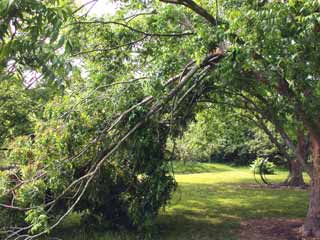 A lightning strike to a tree in one's landscape is a traumatic experience for
both the tree and its caretaker. After checking to see if one's own limbs are
intact, attention quickly shifts to the welfare of the tree. If the lightning
damage has created hazardous broken branches, these should be taken care of quickly.
Photo credit: Herman Auer
A lightning strike to a tree in one's landscape is a traumatic experience for
both the tree and its caretaker. After checking to see if one's own limbs are
intact, attention quickly shifts to the welfare of the tree. If the lightning
damage has created hazardous broken branches, these should be taken care of quickly.
Photo credit: Herman Auer
Question: During the severe weather that occurred a few days ago, one of my trees was struck by lightning. Is there anything I can do to save the tree or is likely to die?
|
UPCOMING PROGRAMS
Home Fruit Growers’ Open House: SATURDAY, May 14: Home Fruit Growers’ Open House for three home fruit orchards in the Santa Fe area. Each site open from 9:00 a.m. to 12:00 Noon. Wide variety of fruit and citrus trees. Visit website at the end of this column for more information and a printable site map. Golf Tournament for 4-H SATURDAY, May 21: Third Annual 4-H Benefit Golf Tournament starts at 1:30 p.m. at the Beacon Lakes Golf Course in League City. For entry fees and information, contact Gayle Walker at the County Extension Office (281-534-3413, ext. 5059). |
Answer: A lightning strike to a tree in one's landscape is a traumatic experience for both the tree and its caretaker. After checking to see if one's own limbs are intact, attention quickly shifts to the welfare of the tree. The morning after an electrical storm, local Extension offices often field questions from concerned homeowners regarding the prognosis for beloved trees and what care might be given to help them survive or recover. Unfortunately and quite accurately for the concerned tree steward, the best answer to these urgent questions is often, "time will tell."
A lightning strike can affect a tree in many ways. Some are immediately obvious and some are not. Sometimes the trunk and/or large branches are splintered. A strike may make continuous grooves in the trunk or main branches. In many cases, the apparent damage may appear minimal while internal injury to the vascular tissues of the trunk and roots is extensive and gradually manifests itself over a period of months or even years.
In some cases, the majority of the damage occurs to the main roots of a tree as the electrical discharge (up to 100 million volts at thousands of amperes) vaporizes the water inside the roots, creating superheated steam. People standing above such roots during a storm may be electrocuted even though they are standing a good distance from the tree's trunk.
It is difficult to predict which trees will be struck by lightning and which are most likely to be seriously injured. In general, lone trees, those tallest in a group or those growing in moist soil have the highest probability of being struck. In the considerable body of lightning lore, certain tree species are commonly listed as more lightning-attractive than others. These include maple, ash, tulip tree, sycamore, poplar, oak, elm, pine, spruce and hemlock. Some of these species, like sycamores, are likely targets because they tend to tower over other species.
Pines and hemlocks may be lightning-prone because of the water that collects on their needles during thunderstorms. One theory explaining why oaks are commonly damaged during electrical storms is that the roughness of the bark prevents uniform trunk wetting, causing the electrical current to jump from surface water to the water inside the trunk.
Human nature causes people to develop strong attachments to trees. It is natural, therefore, to want to take immediate action to help an urban friend survive in the aftermath of a lightning strike. In most cases, however, there is little that can be done to help a tree recover.
Should one apply any of the various wound dressing concoctions commonly used? While most wound dressing concoctions do no harm to the tree, many dressings develop cracks over time that can harbor insects or hold water that lead to decay. Applying a wound dressing may make the caretaker performing the operation feel better, but it is not recommended.
If the lightning damage has created hazardous broken branches, these should be taken care of quickly. However, in most cases, it is best to wait 6 months before doing major (expensive) corrective work to the main trunk. If, during this waiting period, the tree shows no obvious signs of decline, then it may be worth the expense to do major corrective pruning. In the meantime, watering during drought conditions and fertilizing with a moderate rate of nitrogen may help the tree produce callus tissue to compartmentalize wounds.
In many cases, it will become obvious at some point during the waiting period that the tree will not recover and that removal is the best option. My experience has been that a lightning strike does not automatically spell doom to a tree as many such trees are able to make a remarkable recovery given adequate care and time.
Question: Since the last rainstorm, our lawn now looks like a cluster of spaceships from Mars has taken up residence! Where do the mushrooms come from and is there anything to control them? Are they edible?
Answer: Mushrooms have become very common in many lawns since the onset of rainy weather after our rather dry late spring season. They belong to a group of organisms called fungi. Mushrooms are the reproductive portion of the fungi and the vegetative portion (known as hyphae) grows belowground. Since mushrooms lack chlorophyll that is found in green plants, they must derive their food from decaying plants. In home lawns, they will grow on decaying underground roots, bark, and other organic matter found beneath the soil. They are often found in areas that had trees removed some years back.
Some types of mushrooms grow in a distinctive circular-to-elliptical pattern known as a "fairy ring." The mushrooms described here occur in a random pattern and are close relatives of "fairy ring" mushrooms.
When we have periods of high rainfall and warm temperatures (especially after an extended period of dry weather), mushrooms can appear virtually overnight. Save your money–there is nothing you can do to prevent this. Frequent mowing will do more good than anything else.
Although most mushrooms are not poisonous, you must never take chances on eating
wild mushrooms. The abundance of mushrooms in many area lawns provides a greater
opportunity for small children to come in contact with them. Remove mushrooms
as they appear to reduce the temptation they can offer to children.
Dr. Johnson is a horticulturist with the Galveston County
Extension Office of Texas Cooperative Extension, Texas A&M University.
Visit his web site at http://aggie-horticulture.tamu.edu/galveston/index.htm
Gardening: Scale insects and pampas grass - July 17, 2004 article
Gardening: Bananas - August 1, 2004 article
Gardening: August Gardening Calendar - August 16, 2004 article
Gardening: Prepare Now For Fall Gardens - August 26, 2004 article
Gardening: September’s Garden Calendar Includes Fall Pecan Field Day - September 2, 2004 article
Gardening: Ornamental Grasses - September 8, 2004 article
Gardening: Don't Let Landscape Become A High-Maintenance Nightmare - September 22, 2004 article
Gardening: Rose Propagation & Seasonal Decorating Workshops To Be Held - October 13, 2004 article
Gardening: November Is Pansy Time - November 6, 2004 article
Gardening: County Pecan Growers Display Their Successes - November 11, 2004 article
Gardening: Gardeners' Questions On Fall Crops - November 17, 2004 article
Gardening: Gardeners’ Q&As For November - November 28, 2004 article
Gardening: Gardeners' December Checklist Includes Citrus Show On Dec. 9 - December 3, 2004 article
Gardening: Citrus Show A Huge Success With 185 Entries - December 19, 2004 article
Gardening: Trees and Shrubs - December 23, 2004 article
Gardening: Cold Weather Impact - January 4, 2005 article
Gardening:Announcing the 2005 Galveston County Master Gardener Training - January 13, 2005 article
Gardening:Peach & Plum Growers' Workshop To Be Held Saturday, January 29 - January 19, 2005 article
Gardening: Gardening for Texas Wildlife - January 28, 2005 article
Gardening: Extension Activities At The Home & Garden Show On Feb. 26-27 - February 23, 2005 article
Gardening: March Gardening Calendar Includes Seminar On Butterfly Gardening - March 2, 2005 article
Gardening: Gardeners' Q&As From The Galveston Home & Garden Show - March 10, 2005 article
Gardening: Program On Plumeria Offered On March 26- March 29, 2005 article
Gardening: Garden Checklist For April Includes Pecan Field Day - April 6, 2005 article
Gardening: Hints On Harvesting Vegetables For Peak Flavor - April 15, 2005 article
Gardening: Learn About Weed Control - April 27, 2005 article
Gardening:Home Gardening Chores and
May 14 Home Fruit Growers’ Tour - May 5, 2005 article
Gardening: Apples To Home Fruit Growers’ Tour - May 12, 2005 article
© 2004-2006
League City Area News Online.
All rights reserved.
Marilyn Clark.
League City Area News Online, P. O. Box 1693, League City, Texas 77574-1693
Please include your address and phone number for verification purposes.