

|
(alphabetized) |
 Gardening
Gardening
Help with a Landscape Plant ID & Other Q&As
by Dr. William M. Johnson
Galveston County Extension Agent - Horticulture
Submitted for June 8, 2005
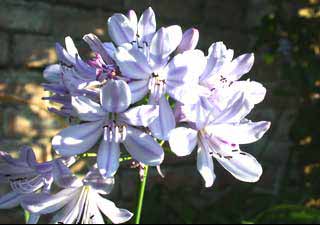 Agapanthus is an underutilized perennial in local landscapes. It is also known as Lily of the Nile and African blue lily. Agapanthus was introduced to this country from South Africa in the seventeenth century. Its botanical name is derived from Greek and translates roughly as "flower of love." Agapanthus bears large, round heads of blue flowers on long, stout stems during late May and June. Photo
credit: William M. Johnson
Agapanthus is an underutilized perennial in local landscapes. It is also known as Lily of the Nile and African blue lily. Agapanthus was introduced to this country from South Africa in the seventeenth century. Its botanical name is derived from Greek and translates roughly as "flower of love." Agapanthus bears large, round heads of blue flowers on long, stout stems during late May and June. Photo
credit: William M. Johnson
Question: Can you identify a plant I have seen growing in a local landscape? It started blooming near the end of May and itís still putting on an eye-catching flower display. The flower heads are round and borne on long slender stalks and the individual flowers are blue.
Answer: The botanical name of the plant you described is Agapanthus. It is one of the few landscape plants where its botanical name is also one of its common names. It is also known as Lily of the Nile and African blue lily.
Agapanthus was introduced to this country from South Africa in the seventeenth century. Its botanical name is derived from Greek and translates roughly as "flower of love."
Agapanthus bears large, round heads of blue flowers on long, stout stems during late May and June. While most varieties have blue flowers which range in shades of light blue to an intense blue, varieties with white flowers are available also. It is also available in standard and dwarf varieties.
The evergreen leaves of the standard varieties are long and strap-shaped and look like large amaryllis leaves. The stem holding the head of flowers may be three feet tall or taller. The dwarf varieties are about half the size of the standard varieties.
Agapanthus is an underutilized perennial in local landscapes. While it is typically grown in ground beds, it may be grown in large wooden or plastic containers. Agapanthus needs a well-drained soil with high organic matter. During periods of dry weather conditions in the summer, be prepared to provide adequate irrigation. During the winter, give it just enough to keep the soil from becoming very dry.
When Agapanthus is grown in containers, it should be provided a dilute liquid fertilizer feeding every two weeks during the spring and summer growing season. When it's grown in a bed, you should fertilize it once in the spring, once in early summer and once in the fall.
Agapanthus blooms freely in pots and ground beds when they become crowded and it may stay in the same container or bed for years. While Agapanthus may be dug and divided anytime during the warm months, the best time is during late September.
Question: I am concerned about all the old insecticides that I have used over the years being taken off the market. The stores seemed to be filled with ones I have never heard of or read about. Are they as good as the ones before?
Answer: The only thing that is constant is change. Over the past few years many of our more popular insecticides, such as Lindane, Dursban and diazinon, have been removed from the marketplace.
They are being replaced with products from Bayer, Ortho, Spectracide, and other companies and are being sold as general-use or all-purpose type sprays. They contain a class of insecticides known as pyrethroids. These chemicals are known for their ability to control insects at low rates. The market place is full of new pyrethroids with names like cyfluthrin, permethrin, and esfenvalerate. They are found under various trade names. They work quite well for the pests for which they are labeled.
Question: My newly transplanted landscape trees have turned yellow and some have died. I have been watering every day. When we dug up the dead trees, they were sitting in a pool of water. I was told to add organic matter to the planting hole and water the trees daily when I bought them, but now I wonder if I over did it. What happened?
Answer: Too much TLC is harmful to plants especially in clay soils. To be more precise, too much TLC when it is misdirected is harmful to plants. And the most common misdirection is wateringóeither too little or too much.
Many of our gumbo clay soils do not drain well at all. The texture of these soils is so fine that the water will not drain well when excessive amounts occur either through watering or heavy rainfall. Adding high organic soil as fill soil in the planting hole in these soils is like planting in a bath tub with a clogged drain. In this case, the bath tub fills up with water, does not drain adequately and plant roots are damaged or killed. It is recommended that the original soil dug from the planting hole be used as fill soil after placement of the root ball in the hole.
Dealing with our gumbo clay soils can be very frustrating. If you have soils of this nature, you need to modify your watering schedule. Depending on the time of year trees are planted, you may have to water 2-to-3 times a week for the first couple of weeks after transplanting. Thereafter, once a week during periods of dry weather is generally enough to get new landscape trees through the first growing season. There is no need to water any newly set plant daily unless you have planted them in a very sandy soil. While we do have sandy soils in a few limited areas in our county, that is a rare commodity in these parts.
So adjust your watering schedule to your soil type and soil moisture conditions. Watering schedules should be based on your ongoing soil conditions, not on a set schedule. Just as people need to drink water when thirsty, new transplants should be watered when soil moisture level is low.
Posted on July 13, 2005
Dr. Johnson is a horticulturist with the Galveston County
Extension Office of Texas Cooperative Extension, Texas A&M University.
Visit his web site at http://aggie-horticulture.tamu.edu/galveston/index.htm
Gardening: Scale insects and pampas grass - July 17, 2004 article
Gardening: Bananas - August 1, 2004 article
Gardening: August Gardening Calendar - August 16, 2004 article
Gardening: Prepare Now For Fall Gardens - August 26, 2004 article
Gardening: September’s Garden Calendar Includes Fall Pecan Field Day - September 2, 2004 article
Gardening: Ornamental Grasses - September 8, 2004 article
Gardening: Don't Let Landscape Become A High-Maintenance Nightmare - September 22, 2004 article
Gardening: Rose Propagation & Seasonal Decorating Workshops To Be Held - October 13, 2004 article
Gardening: November Is Pansy Time - November 6, 2004 article
Gardening: County Pecan Growers Display Their Successes - November 11, 2004 article
Gardening: Gardeners' Questions On Fall Crops - November 17, 2004 article
Gardening: Gardeners’ Q&As For November - November 28, 2004 article
Gardening: Gardeners' December Checklist Includes Citrus Show On Dec. 9 - December 3, 2004 article
Gardening: Citrus Show A Huge Success With 185 Entries - December 19, 2004 article
Gardening: Trees and Shrubs - December 23, 2004 article
Gardening: Cold Weather Impact - January 4, 2005 article
Gardening:Announcing the 2005 Galveston County Master Gardener Training - January 13, 2005 article
Gardening:Peach & Plum Growers' Workshop To Be Held Saturday, January 29 - January 19, 2005 article
Gardening: Gardening for Texas Wildlife - January 28, 2005 article
Gardening: Extension Activities At The Home & Garden Show On Feb. 26-27 - February 23, 2005 article
Gardening: March Gardening Calendar Includes Seminar On Butterfly Gardening - March 2, 2005 article
Gardening: Gardeners' Q&As From The Galveston Home & Garden Show - March 10, 2005 article
Gardening: Program On Plumeria Offered On March 26- March 29, 2005 article
Gardening: Garden Checklist For April Includes Pecan Field Day - April 6, 2005 article
Gardening: Hints On Harvesting Vegetables For Peak Flavor - April 15, 2005 article
Gardening: Learn About Weed Control - April 27, 2005 article
Gardening: Home Gardening Chores and
May 14 Home Fruit Growers’ Tour - May 5, 2005 article
© 2004-2006
League City Area News Online.
All rights reserved.
Marilyn Clark.
League City Area News Online, P. O. Box 1693, League City, Texas 77574-1693
Please include your address and phone number for verification purposes.