

|
(alphabetized) |
 Gardening
Gardening
Gardeners' Q&As for June
by Dr. William M. Johnson
Galveston County Extension Agent - Horticulture
Submitted for June 29, 2005
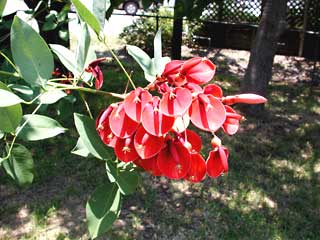 Fireman's cap is a low-care shrub that prefers full sun and a well-draining soil. The crimson-red flowers are shaped like a fireman's cap and attract hummingbirds in spring and summer. Photo
credit: William M. Johnson
Fireman's cap is a low-care shrub that prefers full sun and a well-draining soil. The crimson-red flowers are shaped like a fireman's cap and attract hummingbirds in spring and summer. Photo
credit: William M. Johnson
Question: I recently bought a house and need help in identifying a large shrub that is producing abundant clusters of large pea-shaped flowers that are bright red. There are small thorns on the stems. Can you identify this shrub?
Answer: This shrub is commonly known as fireman's cap or coral tree. It's botanical name is Erythrina crista-galli. Fireman's cap is subject to freezes and may lose its top if freezing weather occurs but it is usually root-hardy. While it is typically a large shrub, it can develop into a small tree which can reach 20-25 feet if not damaged by cold weather.
Blooms are large 18-24 inch panicles of crimson-red flowers that are shaped liked a fireman's cap. Blooms are produced through the summer. Fireman's cap tolerates dry or wet conditions well. It is heat- and drought-tolerant once established. The fireman's cap is a low-care shrub that prefers full sun and a well-draining soil. The flowers also attract hummingbirds in spring and summer.
Q: The leaves on our tomato plants are covered with dark spots. What is this and will it kill the tomatoes?
A: There are numerous fungi that cause the spotting of leaves on tomatoes. Some of the more common ones at this time of the year are gray leafspot, septoria leaf spot, and early blight. All of these fungal spots start small and enlarge. They often start on the leaves nearest the ground and then spread up the plant during the summer. Warm temperatures and ample moisture hasten the spread.
Many of these leaf diseases became more apparent in the last few weeks. There are no cures for these diseases. However, you can slow their spread to new leaves. When watering, do not wet the foliage. Use a mulching material under the plants to reduce splashing of rain from the soil back on the leaves.
There are also several fungicides that homeowners can use to slow the disease such as Daconil 2787 (Ortho's Multi-Purpose Fungicide) applied at 10-14 day internals. Since most tomatoes will soon stop setting fruit due to hot weather, it is not likely to be of much benefit this late in the season.
Q: I have planted a flower bed with annuals such as marigolds, petunias, vinca, and salvia. The plants are a little on the spindly side. What is the best way to encourage them to branch out?
A: Most summer annuals benefit from a good pinching soon after they are planted. Pinching out the top and removing the one single bloom will encourage the plant to branch out. This is sometimes hard to do when you have only one flower per plant. But the flowerless look is short-lived. Many more flowers and a stouter plant will be your reward.
Q: Some of the flower buds on my roses will not open. Other blooms seem discolored around the edges are torn. What could be wrong with them?
A: This sounds like damage from flower thrips. This insect can be one of the most damaging pests of roses as well as other ornamental flowers. They tend to favor white or pale blooms. The mouthparts of thrips shred the petals and damage the flowers. At this time of the year, it will require spraying your roses with an insecticide every 7-10 days because there are so many on the move. You can use Orthene or one of the pyrethrins.
Q: I have been told that I can plant beans, corn, and squash together. The beans are supposed to grow up the corn stalk and the squash will shade the soil and keep insects away. Is it all right to mix these vegetables together?
A: You have referred to the "Three Sisters." The Iroquois nation coined this phrase because corn, bean, and squash were the most important crops they cultivated. Native Americans were very good farmers in addition to being hunters. The seeds of beans were planted with the corn. The corn provided a ready-made trellis for the beans.
You can do the same. Be sure to use pole beans and not bush beans. I can remember my Grandfather planting his pole beans and corn in this manner. As for the squash, it can be planted nearby. I would not put it in the same hole. These plants get too big and need full sun.
Q: How deep should I plant my trees and shrubs?
A: Never transplant ornamental trees and shrubs any deeper than they were already planted. After digging the planting hole only as deep as the root ball, backfill around the root ball using existing soil so that the plant will sit in the hole at the same level it was growing in the container. Research indicates that the addition of organic amendments is not needed.
Q: I was told that compost could be spread over an established lawn. How does one do this? Is there a type of spreader that is preferable? My fertilizer spreader just locks up on compost that I've crumbled though a screen.
A: The simplest way to spread the compost is with a shovel or by hand, then rake it to spread it more evenly. Short of using a tractor PTO-driven manure spreader, I don't think you will find a home fertilizer spreader that will do the job. You will spend most of your time unclogging the spreader. Though it is a bit of work, applying compost to the soil will help your lawn and is worth the effort.
Posted on July 13, 2005
Dr. Johnson is a horticulturist with the Galveston County
Extension Office of Texas Cooperative Extension, Texas A&M University.
Visit his web site at http://aggie-horticulture.tamu.edu/galveston/index.htm
Gardening: Scale insects and pampas grass - July 17, 2004 article
Gardening: Bananas - August 1, 2004 article
Gardening: August Gardening Calendar - August 16, 2004 article
Gardening: Prepare Now For Fall Gardens - August 26, 2004 article
Gardening: September’s Garden Calendar Includes Fall Pecan Field Day - September 2, 2004 article
Gardening: Ornamental Grasses - September 8, 2004 article
Gardening: Don't Let Landscape Become A High-Maintenance Nightmare - September 22, 2004 article
Gardening: Rose Propagation & Seasonal Decorating Workshops To Be Held - October 13, 2004 article
Gardening: November Is Pansy Time - November 6, 2004 article
Gardening: County Pecan Growers Display Their Successes - November 11, 2004 article
Gardening: Gardeners' Questions On Fall Crops - November 17, 2004 article
Gardening: Gardeners’ Q&As For November - November 28, 2004 article
Gardening: Gardeners' December Checklist Includes Citrus Show On Dec. 9 - December 3, 2004 article
Gardening: Citrus Show A Huge Success With 185 Entries - December 19, 2004 article
Gardening: Trees and Shrubs - December 23, 2004 article
Gardening: Cold Weather Impact - January 4, 2005 article
Gardening:Announcing the 2005 Galveston County Master Gardener Training - January 13, 2005 article
Gardening:Peach & Plum Growers' Workshop To Be Held Saturday, January 29 - January 19, 2005 article
Gardening: Gardening for Texas Wildlife - January 28, 2005 article
Gardening: Extension Activities At The Home & Garden Show On Feb. 26-27 - February 23, 2005 article
Gardening: March Gardening Calendar Includes Seminar On Butterfly Gardening - March 2, 2005 article
Gardening: Gardeners' Q&As From The Galveston Home & Garden Show - March 10, 2005 article
Gardening: Program On Plumeria Offered On March 26- March 29, 2005 article
Gardening: Garden Checklist For April Includes Pecan Field Day - April 6, 2005 article
Gardening: Hints On Harvesting Vegetables For Peak Flavor - April 15, 2005 article
Gardening: Learn About Weed Control - April 27, 2005 article
Gardening: Home Gardening Chores and
May 14 Home Fruit Growers’ Tour - May 5, 2005 article
© 2004-2006
League City Area News Online.
All rights reserved.
Marilyn Clark.
League City Area News Online, P. O. Box 1693, League City, Texas 77574-1693
Please include your address and phone number for verification purposes.