

|
(alphabetized) |
 Gardening
Gardening
Fall vegetable gardening workshop set for Saturday, July 29
By Dr. William M. Johnson, Galveston County Extension Agent - Horticulture
July 20, 2006
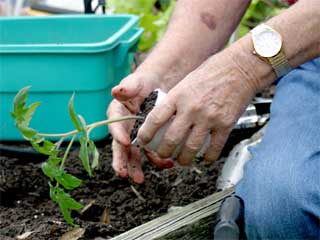
Despite our hot summer temperatures, August is the recommended time to plant
many types of vegetables for a fall garden.
Photo credit: William M. Johnson
So you want to grow garden fresh vegetables this fall. When do you start? Where do you start?
Start out on the right track by attending our educational program entitled "Fall Vegetable Gardening Workshop" on Saturday, July 29, from 9:00-11:30 a.m. at the Galveston County Extension Office located at 5115 Highway 3 in Dickinson.
Luke Stripling will serve as our program speaker and is a Certified Texas Master Gardener. Luke has accumulated a wealth of knowledge and hands-on experience on home vegetable gardening. He will provide information on a variety of topics including soil preparation, types of vegetables that do well during the fall and winter season, variety selection, fertilization, and pest control.
Pre-registration is required due to limited seating. Visit or contact the County Extension Office (281-534-3413, ext. 6) or e-mail your request (GALV3@wt.net) to make your reservation.
Successful fall gardening begins much earlier than the official start of the fall season. Proper timing is probably the most important factor in successful fall gardening. Regardless of variety selected or cultural practices used, if a gardener does not do the right thing at the right time, his or her success rate will decrease.
Many vegetables are well adapted to planting in the summer for fall harvest. Planting a fall garden will extend the gardening season so you can continue to harvest fresh produce during the fall season and even into winter.
Despite our hot summer temperatures, August is the recommended time to plant many types of vegetables for a fall garden. Many gardeners miss this opportunity to have a successful fall garden because they wait until temperatures have moderated to plant.
Some vegetables will need to be seeded or transplanted in August in order to provide adequate time to reach maturity before the onset of cold weather. Some of the best quality garden vegetables in the Upper Gulf Coast are produced and harvested during the fall season when warm, sunny days are followed by cool, humid nights.
Question: The leaves on my crapemyrtles have a gray mold on them. Is this something I should be alarmed about?
Answer: This is one of the powdery mildew diseases and the most important disease of crapemyrtles. It is the more serious in the spring and early summer. The growth of this fungus will coat the leaves causing them to be distorted and stunted. The flower buds will not open properly.
Crapemyrtles will vary in their resistance to this disease. You can reduce the severity of this disease by using a fungicide that is effective on powdery mildew. Effective fungicides are Immunox and Bayleton. To control this disease, make 2 to 3 applications 10-14 days apart.
Question: We had three stumps ground up in our yard. What should I do with these stump holes?
Answer: Remove most of the wood chips or grindings and use it as mulch in natural areas or around trees and shrubs in the lawn. Do not put it around foundation plants. Spreading this material at a depth of 2 inches will not damage or kill your ornamental plants.
After removal of wood chips or grindings from the stump hole, fill it with topsoil. Stump holes will settle over time as the remaining stump rots away. Put extra topsoil in the hole to form a crown to compensate for the settling. I would not plant another tree in this same hole but it would be satisfactory to plant your tree in an undisturbed site nearby.
Question: I have webworms on my mulberry tree. Where do they come from? Are there any effective chemical controls available?
Answer: Webworms are aptly named as they form protective spider-like webs that cover the tips of branches where they feed. Webworms are covered with an abundance of long hairs and their bodies are yellow or greenish-yellow in color. Mulberry trees are their favorite host plant with pecan trees ranking a close second. However, except for pines and other conifers, webworms will settle for having just about any landscape tree or shrub for dinner.
Sprays are probably the most-utilized strategy for webworm control, with conventional and biological ingredients available for homeowner use. Several contact insecticides also are effective for webworms. Sevin (carbaryl) has long been available. More recently, various pyrethroids such as permethrin, cyfluthrin and esfenvalerate are available for homeowner application and are highly effective.
Effective control is also achieved with the use of Dipel and Bio-Worm Killer, both of which are biological or organic-type alternatives. Because the webs produced by the webworms are resistant to water penetration, the addition of a wetting agent (available at garden centers) to the spray mixture is highly recommended.
Since the adult stage is a moth, be on guard for succeeding generations of webworms. Just because you take care of the problem now, you may still have another generation to deal with later. In fact, you should be on the lookout for webworms from now through the fall season.
Dr. Johnson is a horticulturist with the Galveston County
Extension Office of Texas Cooperative Extension, Texas A&M University.
Visit his web site at http://aggie-horticulture.tamu.edu/galveston/index.htm
Gardening: Scale insects and pampas grass - July 17, 2004 article
Gardening: Bananas - August 1, 2004 article
Gardening: August Gardening Calendar - August 16, 2004 article
Gardening: Prepare Now For Fall Gardens - August 26, 2004 article
Gardening: September's Garden Calendar Includes Fall Pecan Field Day - September 2, 2004 article
Gardening: Ornamental Grasses - September 8, 2004 article
Gardening: Don't Let Landscape Become A High-Maintenance Nightmare - September 22, 2004 article
Gardening: Rose Propagation & Seasonal Decorating Workshops To Be Held - October 13, 2004 article
Gardening: November Is Pansy Time - November 6, 2004 article
Gardening: County Pecan Growers Display Their Successes - November 11, 2004 article
Gardening: Gardeners' Questions On Fall Crops - November 17, 2004 article
Gardening: Gardeners' Q&As For November - November 28, 2004 article
Gardening: Gardeners' December Checklist Includes Citrus Show On Dec. 9 - December 3, 2004 article
Gardening: Citrus Show A Huge Success With 185 Entries - December 19, 2004 article
Gardening: Trees and Shrubs - December 23, 2004 article
Gardening: Cold Weather Impact - January 4, 2005 article
Gardening:Announcing the 2005 Galveston County Master Gardener Training - January 13, 2005 article
Gardening:Peach & Plum Growers' Workshop To Be Held Saturday, January 29 - January 19, 2005 article
Gardening: Gardening for Texas Wildlife - January 28, 2005 article
Gardening: Extension Activities At The Home & Garden Show On Feb. 26-27 - February 23, 2005 article
Gardening: March Gardening Calendar Includes Seminar On Butterfly Gardening - March 2, 2005 article
Gardening: Gardeners' Q&As From The Galveston Home & Garden Show - March 10, 2005 article
Gardening: Program On Plumeria Offered On March 26- March 29, 2005 article
Gardening: Garden Checklist For April Includes Pecan Field Day - April 6, 2005 article
Gardening: Hints On Harvesting Vegetables For Peak Flavor - April 15, 2005 article
Gardening: Learn About Weed Control - April 27, 2005 article
Gardening: Home Gardening Chores and
May 14 Home Fruit Growers’ Tour - May 5, 2005 article
© 2004-2006
League City Area News Online.
All rights reserved.
Marilyn Clark.
League City Area News Online, P. O. Box 1693, League City, Texas 77574-1693
Please include your address and phone number for verification purposes.