

|
(alphabetized) |
 Gardening
Gardening
September’s garden calendar includes educational programs
By Dr. William M. Johnson
Galveston County Extension Agent - Horticulture
September 7, 2006
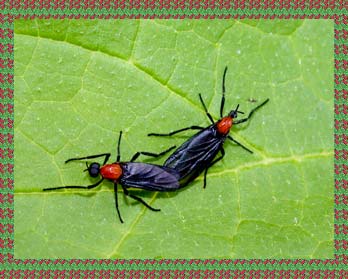 Swarms of lovebugs are common in September. Although their behavior and their
common name may be amusing, their presence in large numbers can be somewhat
of a nuisance when driving.
Photo by Herman Auer
Swarms of lovebugs are common in September. Although their behavior and their
common name may be amusing, their presence in large numbers can be somewhat
of a nuisance when driving.
Photo by Herman Auer
Periodically, I am asked how I decide what topic to write about in this weekly column. Well, sometimes it's fairly straightforward as in last week's column on gardening activities for the month. Other times, selecting the topic may be easy but preparing the article can be tedious. And, sometimes I am just fortunate in that a subject may scream "Write about me!"
This week's subject presented itself as I was dining with friends in a restaurant with a scenic view of Galveston Bay . Our window view of the Bay was mildly obstructed by the in-flight dances of dozens of insects in an amorous mood.
Then I started receiving some calls from concerned residents about "swarms" of small black and orange colored insects that are occurring in many areas of the county. After some meditation, I ultimately made the decision to discuss these critters in this column due to the extent of residents' concerns. I use the words “meditation” and “ultimately” because discussing lovebugs can be a rather delicate subject!
What Are Lovebugs?
These insects belong to a diverse group of insects known as Diptera which includes many species of flies including the common housefly. The common name "lovebug" has been given to these black-bodied flies (with a bright orange-colored head area) because they are most often seen flying around in mating pairs. Even though they are more noticeable as swarms, they commonly occur in less concentrated numbers also.
Where Do They Come From?
The immature or larval stage of lovebugs develops in moist habitats high in organic matter such as roadside ditches, bayous, and swampy areas. Soon after rainy periods in the spring and especially in the fall in wooded Upper Gulf Coast counties of Texas , lovebugs emerge as adults and mate in swarms around roads and buildings (including houses). It has been thought that car fumes contained some properties that were attractive to these flies, but they are naturally attracted to open spaces within their generally wooded habitats.
What Damage Do They Do?
Adult lovebugs spend their time sipping nectar from flowers and searching for mates and mating while hovering in the air. Adult lovebugs do not bite or sting humans.
The immature or larval stages are quite harmless and actually help nature by decomposing dead plant tissues. Although their behavior and their common name may be amusing, their presence in such large numbers can be somewhat of a nuisance.
Cars and trucks driven through these aerial orgies become spattered with these loving bugs. As a result, radiator fins may become clogged causing cars to overheat. Insects spattered on the windshields can obscure vision.
Be sure to clean off insects that had a head-on collision with your vehicle as they can damage the paint finish. Use one of the commercially available products containing petroleum distillates advertised to facilitate the removal of crushed, dried insect parts from auto finishes.
Should They Be Controlled?
Unlike the case for several insect pests in the landscape, we cannot rely on natural enemies to help control lovebugs. In fact, it would appear that the major enemy of lovebugs in an urban environment would be cars, trucks and tractor trailers!
Because of their harmless biology, broad chemical control using insecticides is not recommended and is generally not effective. They do not respond to insect repellents such as citronella and DEET. Certain insecticides, such as fogs and aerosols designed to quickly knock down and kill many types of swarming adult insects, will affect exposed lovebugs.
However, these compounds are readily displaced by wind currents and are generally quick to lose effectiveness relative to the duration of the lovebug swarming period which may last several weeks.
When Do Swarms Occur?
Lovebugs are quite seasonal with May and September being the two major time periods to see swarms. Swarms in September tend to be larger than those occurring in May. In some years, swarms may be small and scattered. In other years, swarms can be huge and commonplace across the county.
Population size is influenced by environmental conditions. Extended periods of high soil moisture levels favor the development of the larval stages, i.e., high populations of lovebugs tend to occur when summer rainfall has been ample. However, populations of adult flies may be drastically reduced by heavy rains.
Time will soon tell whether lovebug swarms will be sizeable across the entire county or occur in scattered swarms. The good news is that lovebug populations will be on the decline near the end of September.
All that can be done is to learn how to cope with lovebug swarms and perhaps marvel a bit at how lovebugs can stay so focused, living up to their amorous reputation despite our actions to wipe them out on the highways!
PROPAGATION WORKSHOPS
The Galveston County Master Gardeners will conduct two workshops on plant propagation. A workshop on “Easy Propagation Techniques for the Home Gardener” will be conducted on Saturday, September 9, 2006, from 9:00 a.m. to 12:00 noon at the Galveston County Extension Office, 5115 Highway 3, in Dickinson.
A second workshop on “How to Graft Your Own Fruit & Nut Trees” will be conducted on Saturday, September 16, from 9:00 a.m. to 12:00 noon. Both workshops will be presented by Master Gardeners Herman Auer, Terry Cuclis, Bert Janke and Anna Wygrys who hold the title of Master Gardener Propagation Specialists in addition to being Texas Master Gardeners.
Program participants will have the opportunity to practice soft tissue propagation and grafting techniques. There is no registration fee but class size is limited and pre-registration is required (by phone at 281-534-3413, ext. 6 or by e-mail at GALV3@wt.net).
Dr. Johnson is a horticulturist with the Galveston County
Extension Office of Texas Cooperative Extension, Texas A&M University.
Visit his web site at http://aggie-horticulture.tamu.edu/galveston/index.htm
ing: Scale insects and pampas grass - July 17, 2004 article
Gardening: Bananas - August 1, 2004 article
Gardening: August Gardening Calendar - August 16, 2004 article
Gardening: Prepare Now For Fall Gardens - August 26, 2004 article
Gardening: September's Garden Calendar Includes Fall Pecan Field Day - September 2, 2004 article
Gardening: Ornamental Grasses - September 8, 2004 article
Gardening: Don't Let Landscape Become A High-Maintenance Nightmare - September 22, 2004 article
Gardening: Rose Propagation & Seasonal Decorating Workshops To Be Held - October 13, 2004 article
Gardening: November Is Pansy Time - November 6, 2004 article
Gardening: County Pecan Growers Display Their Successes - November 11, 2004 article
Gardening: Gardeners' Questions On Fall Crops - November 17, 2004 article
Gardening: Gardeners' Q&As For November - November 28, 2004 article
Gardening: Gardeners' December Checklist Includes Citrus Show On Dec. 9 - December 3, 2004 article
Gardening: Citrus Show A Huge Success With 185 Entries - December 19, 2004 article
Gardening: Trees and Shrubs - December 23, 2004 article
Gardening: Cold Weather Impact - January 4, 2005 article
Gardening:Announcing the 2005 Galveston County Master Gardener Training - January 13, 2005 article
Gardening:Peach & Plum Growers' Workshop To Be Held Saturday, January 29 - January 19, 2005 article
Gardening: Gardening for Texas Wildlife - January 28, 2005 article
Gardening: Extension Activities At The Home & Garden Show On Feb. 26-27 - February 23, 2005 article
Gardening: March Gardening Calendar Includes Seminar On Butterfly Gardening - March 2, 2005 article
Gardening: Gardeners' Q&As From The Galveston Home & Garden Show - March 10, 2005 article
Gardening: Program On Plumeria Offered On March 26- March 29, 2005 article
Gardening: Garden Checklist For April Includes Pecan Field Day - April 6, 2005 article
Gardening: Hints On Harvesting Vegetables For Peak Flavor - April 15, 2005 article
Gardening: Learn About Weed Control - April 27, 2005 article
Gardening: Home Gardening Chores and
May 14 Home Fruit Growers’ Tour - May 5, 2005 article
© 2004-2006
League City Area News Online.
All rights reserved.
Marilyn Clark.
League City Area News Online, P. O. Box 1693, League City, Texas 77574-1693
Please include your address and phone number for verification purposes.