

|
(alphabetized) |
 Gardening
Gardening
Stinging Caterpillars . . .Curious hands beware
By Dr. William M. Johnson
Galveston County Extension Agent - Horticulture
September 14, 2006
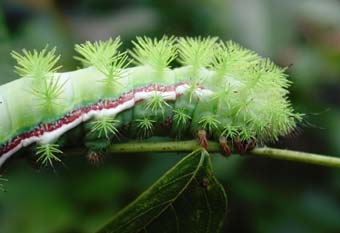 While most caterpillars encountered in the home landscape do not sting, several species of stinging caterpillars occur in the Upper Gulf Coast region. Shown is caterpillar stage of the Io moth. Photo by William M. Johnson
Question: Is it true that some caterpillars can sting you like a hornet? If so, how do we know which ones to be on the lookout for?
Answer: We know that bees, yellow jackets, paper wasps, hornets and fire ants will sting to defend themselves or their nests but many people may be surprised that some caterpillars can also sting.
While most caterpillars encountered in the home landscape do not sting, several species of stinging caterpillars occur in the Upper Gulf Coast region. Stinging caterpillars have stiff poisonous hairs or spines on their bodies which are connected to poison glands. When a person comes into contact with the spines they break and venom is released.
Reaction to this venom varies from mild to severe. Small children and the elderly can have severe reactions. Injury from these caterpillars is most common among children playing in yards and trees. Fortunately these caterpillars are around only in late summer and fall.
There are several stinging caterpillars to be on the lookout for. The puss caterpillar is the worst. This one is covered in gray or brown hair. You cannot see the eyes or the legs. It is about 1 inch long.
The saddleback caterpillar is also common. This one is very colorful and striking in appearance. It too is about 1 inch long and is pale green in color but with a purple or brown center that resembles a saddle on its back. Its sting is less severe than the puss.
The Io moth caterpillar is also around. It grows to about 2 inches in length. The Io moth caterpillar sports a vibrant pale green color and looks like it was designed by a very creative artisan. It has a very striking set of stinging spines that would seem to say “Touch me and you’ll really regret it.” However, the sting is relatively mild.
These are the most common of the stinging caterpillars even though there are a few more. This information is not intended to encourage paranoia about being out in the great outdoors. Most stinging caterpillars feed on leaves of various trees. Avoiding low hanging tree branches would help avoid most encounters with these caterpillars. A good rule of thumb to practice–and to teach children– is that any caterpillars equipped with spines, hairs, fuzz or sporty colorations are best left untouched.
Question: Is the tomato a fruit or a vegetable?
Answer: The growing, marketing, and consumption of vegetables in the United States today has come a long way since small lots were bartered. The field-to-table story of today’s vegetables is a story of big business, and it is sometimes because of the needs of commerce that a fruit is a vegetable, or a vegetable is treated as a fruit.
The tomato is an example. Botanically speaking, the tomato is a fruit, but legally speaking, it is a vegetable; the Supreme Court of the United States said so in 1893. An importer had argued that tomatoes were fruit and, therefore, not subject to a duty in effect at that time.
The Court held that the tomato is a vegetable because it was usually served at dinner in, with, or after the soup, or with fish or meats that constitute the main part of a meal. This is less true now than it was then, for today, a much larger part of our tomato crop is made into juice; however, the tomato remains, legally, a vegetable.
Botanically speaking, snap or green beans, the pods of peas, the garden pepper, the okra pod, and many others, are also fruits. But no one doubts that they are vegetables. The cucumber and muskmelon are closely-related fruits; both are the genus Cucumis. They are similar in habits of growth and in structure, both are grown by truck farms using similar methods, they move through the same channels of trade, and both are eaten raw.
Yet we always think of cucumbers as vegetables and of muskmelons as fruit. While it is custom which seems to dictate which plants are treated as vegetables and which as fruit, regardless of how they may be classified, they all taste great when grown in, and harvested fresh from, the home garden!
Question: I’ve seen numerous tiny black insects crawling on the surface of the potting soil of my houseplants? They look like gnats and will cluster around the ceiling lights? What are they and what should I do to control them?
Answer: The tiny black insects are called fungus gnats. Although they are a nuisance, they're not harmful to plants. An adult fungus gnat will deposit her eggs on the surface of potting soils that are moist and high in organic matter.
Fungus gnats are best controlled by controlling moisture levels of the potting soil since the larval stage must have fairly high levels of moisture to survive in addition to the organic matter on which they feed. Therefore, effective long term control of fungus gnats depends primarily on allowing the soil to become moderately dry between waterings.
Since most, but not all houseplants, should be watered in this manner anyway, it will not affect the health of your plants. If need be however, a soil drench using malathion or Sevin will control fungus gnats.
ORCHID SHOW & SALE ON SEPTEMBER 16 & 17
Mention orchids to many gardeners and you will likely get two responses. The first likely response is that orchid flowers are strikingly beautiful and very elegant. The next likely response is that orchids are very difficult or next-to-impossible to grow and that all orchids are very expensive to purchase.
The first notation is well-based. Unfortunately, the second notation is based on myth as there are many types of orchids that can be grown indoors and purchased at a reasonable price. In fact, orchids have become more readily available and they now rank as a popular flowering houseplant.
If you have an interest in growing orchids, the Orchid Show & Sale would be an excellent opportunity for getting started. The 2006 show will be held on Saturday, September 16, from 9:00 a.m. to 6:00 p.m., and Sunday, September 17, from 9:00 a.m. to 4:00 p.m., at the Nessler Center located at 2010 5th Avenue North in Texas City .
The Galveston Orchid Society is sponsoring this event and members will be available to answer questions. The theme for this year’s show is "Orchid Fantasy." Admission is $2 for adults and children over 12.
Dr. Johnson is a horticulturist with the Galveston County
Extension Office of Texas Cooperative Extension, Texas A&M University.
Visit his web site at http://aggie-horticulture.tamu.edu/galveston/index.htm
ing: Scale insects and pampas grass - July 17, 2004 article
Gardening: Bananas - August 1, 2004 article
Gardening: August Gardening Calendar - August 16, 2004 article
Gardening: Prepare Now For Fall Gardens - August 26, 2004 article
Gardening: September's Garden Calendar Includes Fall Pecan Field Day - September 2, 2004 article
Gardening: Ornamental Grasses - September 8, 2004 article
Gardening: Don't Let Landscape Become A High-Maintenance Nightmare - September 22, 2004 article
Gardening: Rose Propagation & Seasonal Decorating Workshops To Be Held - October 13, 2004 article
Gardening: November Is Pansy Time - November 6, 2004 article
Gardening: County Pecan Growers Display Their Successes - November 11, 2004 article
Gardening: Gardeners' Questions On Fall Crops - November 17, 2004 article
Gardening: Gardeners' Q&As For November - November 28, 2004 article
Gardening: Gardeners' December Checklist Includes Citrus Show On Dec. 9 - December 3, 2004 article
Gardening: Citrus Show A Huge Success With 185 Entries - December 19, 2004 article
Gardening: Trees and Shrubs - December 23, 2004 article
Gardening: Cold Weather Impact - January 4, 2005 article
Gardening:Announcing the 2005 Galveston County Master Gardener Training - January 13, 2005 article
Gardening:Peach & Plum Growers' Workshop To Be Held Saturday, January 29 - January 19, 2005 article
Gardening: Gardening for Texas Wildlife - January 28, 2005 article
Gardening: Extension Activities At The Home & Garden Show On Feb. 26-27 - February 23, 2005 article
Gardening: March Gardening Calendar Includes Seminar On Butterfly Gardening - March 2, 2005 article
Gardening: Gardeners' Q&As From The Galveston Home & Garden Show - March 10, 2005 article
Gardening: Program On Plumeria Offered On March 26- March 29, 2005 article
Gardening: Garden Checklist For April Includes Pecan Field Day - April 6, 2005 article
Gardening: Hints On Harvesting Vegetables For Peak Flavor - April 15, 2005 article
Gardening: Learn About Weed Control - April 27, 2005 article
Gardening: Home Gardening Chores and
May 14 Home Fruit Growers’ Tour - May 5, 2005 article
© 2004-2006
League City Area News Online.
All rights reserved.
Marilyn Clark.
League City Area News Online, P. O. Box 1693, League City, Texas 77574-1693
Please include your address and phone number for verification purposes.