

|
(alphabetized) |
 Gardening
Gardening
Landscape Trees Damaged By Rita?
Don’t eliminate without careful evaluation
by Dr. William M. Johnson, Galveston County Extension Agent - Horticulture
October 19, 2005
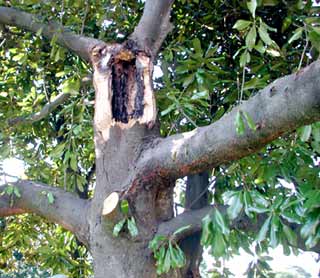 Trees
have an amazing ability to recover from storm damage. The first step is to
assess the damage. Before writing off a damaged tree as a "goner," it
should be carefully evaluated by an experienced tree professional. Photo Credit: William M. Johnson
Trees
have an amazing ability to recover from storm damage. The first step is to
assess the damage. Before writing off a damaged tree as a "goner," it
should be carefully evaluated by an experienced tree professional. Photo Credit: William M. Johnson
We were spared the full wrath of Hurricane Rita. Even so, we will have memorable tales to spin about how Hurricane Rita impacted our lives.
Hurricane Rita left trees looking like there’s no tomorrow for many of our neighbors in East Texas and Louisiana. While most trees in our area escaped with relatively little damage, there were some instances where trees were blown over and many instances where major limbs were broken or damaged, foliage was shredded or stripped, or the bark had been torn or gouged. The remains of many trees can be seen but at first glance what may look like mortal wounds are not necessarily fatal to a tree.
Trees have an amazing ability to recover from storm damage. The first step is to assess the damage. Before writing off a damaged tree as a "goner," evaluate trees by asking the following questions:
Other than the storm damage, is the tree basically healthy and vigorous? If the tree is basically healthy, is not creating a hazard, and did not suffer major structural damage, it will generally recover if first aid measures are applied immediately after the storm.
Are major limbs broken? The larger a broken limb is, the harder it will be for the tree to recover from the damage. If a majority of the main branches are gone, the tree may have little chance of surviving.
Has the leader (the main upward-trending branch on most trees) been lost? In species where a leader is important to upward growth or desirable to appearance, it may have to be a judgment call. The tree may live without its leader, but at best would be a stunted or deformed version of the original.
Is at least 50 percent of the tree’s crown (branches and leaves) still intact? This is a good rule of thumb on tree survivability. A tree with less than half of its branches remaining may not be able to produce enough foliage to nourish the tree through another season.
How big are the wounds where branches have been broken or bark has been damaged? The larger the wound is in relation to the size of the limb, the less likely it is to heal, leaving the tree vulnerable to disease and pests. A 2-3 inch wound on a 12-inch diameter limb will seal over with new bark within a couple of years.
Are there remaining branches that can form a new branch structure? The remaining limbs will grow more vigorously as the tree tries to replace its missing foliage. Look to see if branches are in place that can eventually fill out the tree’s appearance.
Is the tree of a desirable species for its location? If the tree is in the wrong location (such as a potentially tall tree beneath a power line), or an undesirable species for the property (messy fruit, etc.), it may be best to remove it if it has serious damage.
The questions listed above are intended to help you make informed decisions about your trees. In general, the answer as to what to do about a particular tree will fall into one of the following three categories:
It’s a "keeper." If damage is relatively slight, prune any broken branches, repair torn bark or rough edges around wounds, and let the tree begin the process of wound repair.
Wait and See. If a valuable tree appears to be a borderline case, resist the temptation to simply cut the tree down and be done with it. In such cases, it may be best to stand back for a while and think it over. Remember that time is on your side. After careful pruning of broken branches, give the tree some time to recover. A final decision can be made later. The majority of trees may be classified into this category.
Say Goodbye. Some trees simply cannot be saved or are not worth saving. If the tree already has been weakened by disease, if the trunk is split, or more than 50 percent of the crown is gone, the tree has lost its survival edge. Remember, photosynthesis is the process by which plants grow. Photosynthesis requires sufficient leaves (or needles) to capture sunlight and feed the tree. Significant loss of limbs and leaf sites will drastically reduce the tree’s photosynthesis capacity and ultimately, its ability to recover and survive.
Some trees may have damage that’s too close to call, or may have hidden damage. To help with such questions, a tree professional may be needed to help you decide what to do about your trees. Don’t hire just anyone who shows up at your door following a storm. Ask around for references and experiences by friends and neighbors.
One additional recommendation regarding the application of pruning paint to pruned areas–resist the habit or temptation to do so! Many pruning paint compounds are black and contain asphalt. This black material absorbs our intense Texas sunlight and can become quite hot if exposed to direct sunlight resulting in damage to tender cells that the tree produces to close the pruning wound and in that manner delays wound closure and compartmentalization. Lighter-colored materials do less damage, but any containing a petroleum-based solvent can damage newly developing wound closure cells. Scientific research has shown that the application of a pruning paint is not necessary.
Dr. Johnson is a horticulturist with the Galveston County
Extension Office of Texas Cooperative Extension, Texas A&M University.
Visit his web site at http://aggie-horticulture.tamu.edu/galveston/index.htm
Posted: 10/20/05 4:40 a.m. CST
Gardening: Scale insects and pampas grass - July 17, 2004 article
Gardening: Bananas - August 1, 2004 article
Gardening: August Gardening Calendar - August 16, 2004 article
Gardening: Prepare Now For Fall Gardens - August 26, 2004 article
Gardening: September's Garden Calendar Includes Fall Pecan Field Day - September 2, 2004 article
Gardening: Ornamental Grasses - September 8, 2004 article
Gardening: Don't Let Landscape Become A High-Maintenance Nightmare - September 22, 2004 article
Gardening: Rose Propagation & Seasonal Decorating Workshops To Be Held - October 13, 2004 article
Gardening: November Is Pansy Time - November 6, 2004 article
Gardening: County Pecan Growers Display Their Successes - November 11, 2004 article
Gardening: Gardeners' Questions On Fall Crops - November 17, 2004 article
Gardening: Gardeners' Q&As For November - November 28, 2004 article
Gardening: Gardeners' December Checklist Includes Citrus Show On Dec. 9 - December 3, 2004 article
Gardening: Citrus Show A Huge Success With 185 Entries - December 19, 2004 article
Gardening: Trees and Shrubs - December 23, 2004 article
Gardening: Cold Weather Impact - January 4, 2005 article
Gardening:Announcing the 2005 Galveston County Master Gardener Training - January 13, 2005 article
Gardening:Peach & Plum Growers' Workshop To Be Held Saturday, January 29 - January 19, 2005 article
Gardening: Gardening for Texas Wildlife - January 28, 2005 article
Gardening: Extension Activities At The Home & Garden Show On Feb. 26-27 - February 23, 2005 article
Gardening: March Gardening Calendar Includes Seminar On Butterfly Gardening - March 2, 2005 article
Gardening: Gardeners' Q&As From The Galveston Home & Garden Show - March 10, 2005 article
Gardening: Program On Plumeria Offered On March 26- March 29, 2005 article
Gardening: Garden Checklist For April Includes Pecan Field Day - April 6, 2005 article
Gardening: Hints On Harvesting Vegetables For Peak Flavor - April 15, 2005 article
Gardening: Learn About Weed Control - April 27, 2005 article
Gardening: Home Gardening Chores and
May 14 Home Fruit Growers’ Tour - May 5, 2005 article
© 2004-2006
League City Area News Online.
All rights reserved.
Marilyn Clark.
League City Area News Online, P. O. Box 1693, League City, Texas 77574-1693
Please include your address and phone number for verification purposes.