

|
(alphabetized) |
 Gardening
Gardening
Gardeners' questions on fall crops
By Dr. William M. Johnson
Galveston County Extension Agent - Horticulture
November 24, 2006
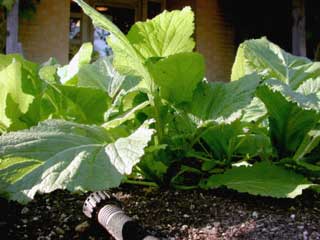 Fall
gardening is well worth the effort and can provide tasty rewards with a variety
of fast-growing salad crops.
Fall
gardening is well worth the effort and can provide tasty rewards with a variety
of fast-growing salad crops.
Photo by
William M. Johnson.
Q: What is the difference between onion sets and onion transplants?
A: Although many Texas gardeners use these terms interchangeably, there is a difference. An onion "set" is actually a small bulb, generally 1/2 to 1 inch in diameter. An onion set is produced under conditions which caused young onion plants to rapidly make a small bulb which, when planted in the garden, will produce a larger bulb.
An onion transplant is an onion plant typically ranging from 8-to-10 weeks old which has not gone through the bulbing process and, if planted at the right time, will produce a large bulb. November is an excellent time to plant transplants of the 1015Y onion variety and several area garden supply outlets have these onions in stock.
Q: Are broccoli leaves good to eat?
A: Yes. As a matter of fact, most people would have a hard time distinguishing between the young leaves of broccoli and those of collard greens. Harvest and prepare only young and tender leaves as older leaves of broccoli become tough and often develop a somewhat bitter or off-taste.
Q: Are ornamental cabbages or kales edible?
A: There are certain varieties of cabbage and kale that produce decorative, non-heading plants with green or purple leaves and colorful white, cream, pink, red or purple interleaves. These are sold as "flowering cabbage" and can be attractively used as edging or for low, colorful accent plants in flower beds. Ornamental cabbage, like other members of the kale crop family, does best when it matures under cool weather conditions. While the leaves are edible, they are rather tough and strong in flavor.
Q: I am growing cauliflower for the first time. I read somewhere that it must be blanched to reached its best quality. How does one blanch cauliflower?
A: Blanching of cauliflower refers to protecting the heads from sunlight. Unblanched heads will often be yellowish-green in color while blanched heads are white. When the head begins to enlarge, the outer leaves should be pulled over the head and held together with a rubber band or soft twine to block direct exposure to sunlight.
Q: What causes my turnips greens to often have a bitter and pungent taste?
A: Conditions which result in slow growth or stress of turnips will often cause the leaves to have a bitter or off-flavor. This condition is most prevalent when turnip greens mature under relatively high temperatures in combination with unfavorable growing conditions such as low soil fertility or low soil moisture.
Q: What causes the bulbs of radishes to crack?
A: This is usually a matter of waiting too long before harvesting the radishes. Cracking can also be caused by excessive fluctuations in soil moisture (especially when turnips are near maturity) which causes the mature bulb to swell and crack. Since the seeding to harvest period is rather short for radishes, it is important to maintain adequate and even soil moisture conditions throughout the growing period.
Q: Last fall, some heads of my cabbages split after reaching maturity. What can I do to prevent this from happening to my cabbages this fall?
A: Once cabbage heads are fully solid and mature, they may split after a heavy rain because of the force exerted by higher internal water pressure brought on after plant roots absorb an excessive amount of water.
To delay this splitting for several days or weeks, simply pull the plant upward until a few of the roots break. This procedure, called "lifting," cuts down on the amount of water entering the plant and reduces splitting. Be sure the cabbage is fully mature before practicing this operation. As with radishes, maintaining even soil moisture conditions will also help reduce splitting.
Q: I have several gourds that are mature. I want to harvest and prepare then for decorating. How should I go about this?
A: Gourds are ready for harvest when the stems dry and turn brown. It is best to harvest gourds before frost. Mature gourds that have a hardened shell will survive a light frost, but less-developed gourds will be damaged.
Gourds should be cut from the vine with a few inches of the stem attached. Take care not to bruise the gourds during harvest, as this increases the likelihood of decay during the curing process. Discard any fruit that is rotten, bruised or immature.
After harvesting, gourds should be cleaned in warm, mildly soapy water and then thoroughly rinse and dry. A small amount of a household bleach added to the rinse water can reduce problems with decay organisms.
Lay the gourds on several layers of newspaper in a dry area to remove surface moisture. Do not dry in direct sunlight as gourds can lose some of their color. It is best to use fully mature gourds as immature specimens of some species may take several months to dry completely.
Keeping gourds cooler than 65 degrees F. during the drying and curing process will help retard shriveling. Sanding and scraping the surface of some gourds improves drying and enhances their appearance. Gourds should be thoroughly dried before shellac is applied. Some gourds can be used without applying wax or shellac, but such treatment makes them more attractive.
Dr. Johnson is a horticulturist with the Galveston County
Extension Office of Texas Cooperative Extension, Texas A&M University.
Visit his web site at http://aggie-horticulture.tamu.edu/galveston/index.htm
ing: Scale insects and pampas grass - July 17, 2004 article
Gardening: Bananas - August 1, 2004 article
Gardening: August Gardening Calendar - August 16, 2004 article
Gardening: Prepare Now For Fall Gardens - August 26, 2004 article
Gardening: September's Garden Calendar Includes Fall Pecan Field Day - September 2, 2004 article
Gardening: Ornamental Grasses - September 8, 2004 article
Gardening: Don't Let Landscape Become A High-Maintenance Nightmare - September 22, 2004 article
Gardening: Rose Propagation & Seasonal Decorating Workshops To Be Held - October 13, 2004 article
Gardening: November Is Pansy Time - November 6, 2004 article
Gardening: County Pecan Growers Display Their Successes - November 11, 2004 article
Gardening: Gardeners' Questions On Fall Crops - November 17, 2004 article
Gardening: Gardeners' Q&As For November - November 28, 2004 article
Gardening: Gardeners' December Checklist Includes Citrus Show On Dec. 9 - December 3, 2004 article
Gardening: Citrus Show A Huge Success With 185 Entries - December 19, 2004 article
Gardening: Trees and Shrubs - December 23, 2004 article
Gardening: Cold Weather Impact - January 4, 2005 article
Gardening:Announcing the 2005 Galveston County Master Gardener Training - January 13, 2005 article
Gardening:Peach & Plum Growers' Workshop To Be Held Saturday, January 29 - January 19, 2005 article
Gardening: Gardening for Texas Wildlife - January 28, 2005 article
Gardening: Extension Activities At The Home & Garden Show On Feb. 26-27 - February 23, 2005 article
Gardening: March Gardening Calendar Includes Seminar On Butterfly Gardening - March 2, 2005 article
Gardening: Gardeners' Q&As From The Galveston Home & Garden Show - March 10, 2005 article
Gardening: Program On Plumeria Offered On March 26- March 29, 2005 article
Gardening: Garden Checklist For April Includes Pecan Field Day - April 6, 2005 article
Gardening: Hints On Harvesting Vegetables For Peak Flavor - April 15, 2005 article
Gardening: Learn About Weed Control - April 27, 2005 article
Gardening: Home Gardening Chores and
May 14 Home Fruit Growers’ Tour - May 5, 2005 article
© 2004-2006
League City Area News Online.
All rights reserved.
Marilyn Clark.
League City Area News Online, P. O. Box 1693, League City, Texas 77574-1693
Please include your address and phone number for verification purposes.