

|
(alphabetized) |
 Gardening
Gardening
Now Is The Ideal Time For Planting Trees & Shrubs
by Dr. William M. Johnson, Galveston County Extension Agent - Horticulture
December 7, 2005
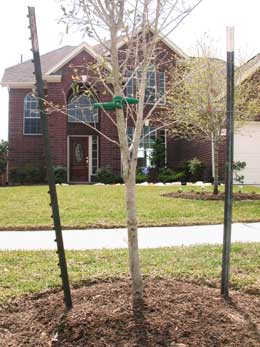 Late
fall through early winter is the ideal time period to plant hardy trees and
shrubs in the landscape as they less likely to suffer from transplant shock. Photo Credit: Dr. William
M. Johnson
Late
fall through early winter is the ideal time period to plant hardy trees and
shrubs in the landscape as they less likely to suffer from transplant shock. Photo Credit: Dr. William
M. Johnson
I wish more gardeners understood that late fall through early winter is a primary planting season in Texas Upper Gulf Coast. Over the years, horticulturists have tried to get the word out that November through January is the ideal time period to plant hardy trees and shrubs in the landscape.
Planting in late November through December is especially good, since trees and shrubs planted now benefit in several ways. The plants are dormant during this time and are less likely to suffer as much from transplant shock. In addition, the cool weather and regular rainfall typical during the winter here allow the new plantings to settle in and adjust with little stress (and less work for you watering them). Better yet, hardy trees and shrubs are not damaged by normal winter freezes, even if newly planted.
Organic Gardening SeminarIn the world of gardening, organic refers to a method of gardening that takes its cues from nature as a guide for doing things like improving the soil and managing pests and diseases without resorting to the use of synthetic or manmade chemicals of any kind. Is organic gardening a realistic option for Gulf Coast gardeners given the wide diversity of disease problems and insect pests that occur in our subtropical growing environment? Diane Norman of the Texas Organic Growers Association will discuss organic gardening alternatives in a seminar on “Organic Gardening in the Gulf Coast” on Saturday, December 17, from 9:00-11:30 a.m. at the Galveston County Extension Office. Easy steps and helpful hints will be provided on how to grow a beautiful, bountiful, organic garden. Come learn some great alternatives to make your garden a healthier place! No fee but seat reservation is required (281-534-3413, Ext. 6 or GALV3@wt.net). |
The roots of trees and shrubs will actively grow during the fall and early winter, so planting in fall allows them to become well established prior to spring growth. By May of next year, trees and shrubs planted now will have developed better established root systems than those planted next spring. This will increase their ability to absorb water and survive that first stressful summer after planting.
Selecting Trees for the Landscape
When selecting trees to plant, keep in mind there is no one perfect tree. All trees have advantages and disadvantages, depending on the planting location and desired characteristics.
To help you make the best choices, here are some points you need to consider:
- Select a tree that will mature at the appropriate size. A small patio might benefit from a small 25-foot tall tree planted nearby but would be completely overwhelmed by a large tree. Planting a tree that will grow too large for its location is one of the most common mistakes people make (along with planting too many trees). Find out the mature size a tree will achieve before you plant it.
-Think about the purpose of the tree and why it is needed. This will help you determine what characteristics the tree should have such as its shape, size and rate of growth. Ornamental features, such as flowers, attractive berries, brightly colored fall foliage or unusual bark, also should be considered.
- Decide if you want a tree that retains its foliage year-round (evergreen) or loses its leaves in the winter (deciduous). Deciduous trees are particularly useful where you want shade in the summer and sun in the winter. Small to medium-size evergreen trees are useful as sound barriers or privacy screens.
- Choose trees that are well-adapted to our local growing conditions. They must be able to tolerate long, hot summers and mild winters. Those conditions make a variety of northern species you might see in catalogs unsuitable for our area.
- Don't forget to check the location of overhead power lines, and if you must plant under them, use small, low-growing trees. Also consider walks, drives and other paved surfaces that may be damaged by the roots of large trees. Locate large trees at least 15 feet away from paved surfaces and your house.
Tree Planting Guidelines
Planting trees properly is not difficult, but it can make the difference between success and failure. Whether the tree is balled and burlapped or container grown, dig the hole at least twice the diameter of the root ball and no deeper than the height of the root ball. When placed into the hole, the root ball should sit on solid, undisturbed soil.
Remove a container-grown tree from its container and place the tree gently in the hole. A root ball tightly packed with thick encircling roots indicates a root-bound condition. Try to unwrap or open up the root ball to encourage the roots to spread into the surrounding soil.
Place a balled and burlapped tree gently in the hole with the burlap intact. Once the tree is in the hole, pull out nails that pin the burlap around the root ball, remove any nylon twine or wire supports that may have been used and fold down the burlap.
The top of the root ball should be level with or slightly above the surrounding soil. It is very critical that you do not plant the tree too deep.
Thoroughly pulverize the soil you dug out of the hole and use this soil–without any soil amendments–to backfill around the tree. Add soil around the tree until the hole is about half full. Then firm the soil to eliminate air pockets, but do not pack it tight. Finish filling the hole, firm again and then water the tree thoroughly to settle it in.
Generally, we do not fertilize newly planted trees, but a slow-release fertilizer may be added to the upper 6 inches of soil when filling the hole. If the tree is tall enough to be unstable, it should be staked. Otherwise, that's not necessary.
Dr. Johnson is a horticulturist with the Galveston County
Extension Office of Texas Cooperative Extension, Texas A&M University.
Visit his web site at http://aggie-horticulture.tamu.edu/galveston/index.htm
Gardening: Scale insects and pampas grass - July 17, 2004 article
Gardening: Bananas - August 1, 2004 article
Gardening: August Gardening Calendar - August 16, 2004 article
Gardening: Prepare Now For Fall Gardens - August 26, 2004 article
Gardening: September's Garden Calendar Includes Fall Pecan Field Day - September 2, 2004 article
Gardening: Ornamental Grasses - September 8, 2004 article
Gardening: Don't Let Landscape Become A High-Maintenance Nightmare - September 22, 2004 article
Gardening: Rose Propagation & Seasonal Decorating Workshops To Be Held - October 13, 2004 article
Gardening: November Is Pansy Time - November 6, 2004 article
Gardening: County Pecan Growers Display Their Successes - November 11, 2004 article
Gardening: Gardeners' Questions On Fall Crops - November 17, 2004 article
Gardening: Gardeners' Q&As For November - November 28, 2004 article
Gardening: Gardeners' December Checklist Includes Citrus Show On Dec. 9 - December 3, 2004 article
Gardening: Citrus Show A Huge Success With 185 Entries - December 19, 2004 article
Gardening: Trees and Shrubs - December 23, 2004 article
Gardening: Cold Weather Impact - January 4, 2005 article
Gardening:Announcing the 2005 Galveston County Master Gardener Training - January 13, 2005 article
Gardening:Peach & Plum Growers' Workshop To Be Held Saturday, January 29 - January 19, 2005 article
Gardening: Gardening for Texas Wildlife - January 28, 2005 article
Gardening: Extension Activities At The Home & Garden Show On Feb. 26-27 - February 23, 2005 article
Gardening: March Gardening Calendar Includes Seminar On Butterfly Gardening - March 2, 2005 article
Gardening: Gardeners' Q&As From The Galveston Home & Garden Show - March 10, 2005 article
Gardening: Program On Plumeria Offered On March 26- March 29, 2005 article
Gardening: Garden Checklist For April Includes Pecan Field Day - April 6, 2005 article
Gardening: Hints On Harvesting Vegetables For Peak Flavor - April 15, 2005 article
Gardening: Learn About Weed Control - April 27, 2005 article
Gardening: Home Gardening Chores and
May 14 Home Fruit Growers’ Tour - May 5, 2005 article
© 2004-2006
League City Area News Online.
All rights reserved.
Marilyn Clark.
League City Area News Online, P. O. Box 1693, League City, Texas 77574-1693
Please include your address and phone number for verification purposes.