

|
(alphabetized) |
 Gardening
Gardening
Poinsettia: Vibrant Holiday Plant Has Roots In History And Legend
by Dr. William M. Johnson, Galveston County Extension Agent - Horticulture
December 14, 2005
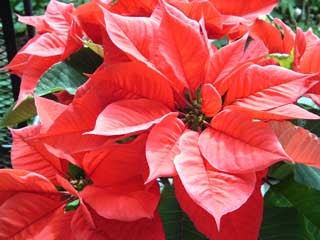 Poinsettias
have been admired for centuries for their colorful red bracts. After bringing
home the perfect poinsettia, the key to longevity is bright light, moderate
temperatures and proper watering. Photo
Credit: Suzanne Christensen, master gardener
Poinsettias
have been admired for centuries for their colorful red bracts. After bringing
home the perfect poinsettia, the key to longevity is bright light, moderate
temperatures and proper watering. Photo
Credit: Suzanne Christensen, master gardener
Christmas brings with it many legends and traditions. The poinsettia, Euphorbia pulcherrima, is a great example of both. This plant is native to Mexico and is part of the family Euphorbiaceae along with plants such as the crown of thorns (E. milii) and pencil cactus (E. tirucalli).
Poinsettias have been admired for centuries for their colorful red bracts in the late fall. The Aztecs cultivated it in an area near present-day Taxco before Christianity came to the Western Hemisphere. Among its admirers is the last Aztec King, Montezuma, who reportedly had poinsettias brought into what now is Mexico City by caravans because they could not be grown in the high altitude.
It wasn't until the 17th century that it was used in Christmas celebrations. A group of Franciscan priests near Taxco began using the flower in nativity processions because of the brilliant red color and holiday blooming time.
Legend of a Girl
Poinsettias came to the United States in 1825 by Robert Poinsett, the first U.S. Ambassador to Mexico and an avid botanist. He had several sent to his home in Greenville, South Carolina, and proceeded to distribute them to botanical gardens and friends. Since then, the poinsettia has become the No. 1 floriculture crop in the United States, even though it is only grown for the holiday season of sales.
Beyond the history of this plant, there's a touching Mexican legend that tells of a poor Mexican girl, Pepita, who had no gift to present the Christ Child at Christmas Eve services. As Pepita walked to the chapel with her cousin Pedro, her heart was filled with sadness. Pedro tried to console her by telling her that even the most humble gift would be acceptable. Not knowing what to do, Pepita knelt by the roadside and gathered a handful of common weeds, fashioning them into a small bouquet.
Pepita fought back a tear as she entered the small village chapel. As she approached the altar, she felt her spirit lift as she knelt to lay the bouquet at the foot of the nativity scene. Suddenly, the bouquet of weeds burst into blooms of brilliant red, and all who saw them were certain that they had witnessed a Christmas miracle right before their eyes. From that day on, the bright red flowers were known as the Flores de Noche Buena or Flowers of the Holy Night, for they bloomed each year during the Christmas season.
That's the legend, but science has proven poinsettias to be photoperiodic which means that it blooms in response to short-day lengths or to be more accurate, long nights. During winter, as days get shorter and nights grow longer, the poinsettias naturally go into bloom in the northern hemisphere.
The colorful "flowers" that we see are really bracts, specialized leaves that attract insects to pollinate the inconspicuous flowers. Bracts last much longer than traditional flower petals, allowing us to enjoy the color for extended periods. The actual poinsettia flowers are the small yellow centers of the bloom called cyathia.
Know What to Look For
When selecting a poinsettia, look for a plant with fresh, brightly colored bracts. Be sure to also inspect the condition of the small flowers–if most or all of the yellow centers are falling off, the plant is past its prime. Also, drying and curling lower leaves are a sign of water stress. Plants should have strong branches. Poinsettias are delicate, and stem breakage is common, especially in multi-branched, low-spreading plants.
Once you pick that perfect poinsettia, the key to longevity is bright light, moderate temperatures and proper watering. Poinsettias will do best near a bright sunny window that receives at least six hours of light. Low light levels will cause bracts to fade along with premature dropping of cyathia and leaves. Temperatures around 70 degrees are ideal; high temperatures will shorten the life of the plant. Also, try to avoid placing the plant in a draft from open windows or heater vents.
Watering is another concern for consumers. First of all, if the plant comes in a foil or plastic pot cover, make sure you have drainage holes in the bottom. If you don't, the plant’s root system will likely suffer from high soil moisture levels which can result in root rots.
As with its succulent relatives, it is best to let the soil moderately dry out before watering. Be careful not to let the plant dry out to the point that it wilts. The plant will recover somewhat, but the stress will usually result in leaf drop or curling, curling leaves, leaf burn and shortened plant life.
The best way to check for water is to feel the soil. If it is dry to the touch about an inch down, it needs water. Checking the weight of the pot will also give you an indication to dryness. Note the weight of the pot when it is fully watered. As the soil dries, it will become very light. If the peat-based soil becomes extremely dry, it may take two or three waterings to completely rehydrate the soil. Also avoid using fertilizer when watering during flowering.
The poinsettia is an easy plant to grow. It's brilliant red bracts will fill your home with color and stories.
Dr. Johnson is a horticulturist with the Galveston County
Extension Office of Texas Cooperative Extension, Texas A&M University.
Visit his web site at http://aggie-horticulture.tamu.edu/galveston/index.htm
Gardening: Scale insects and pampas grass - July 17, 2004 article
Gardening: Bananas - August 1, 2004 article
Gardening: August Gardening Calendar - August 16, 2004 article
Gardening: Prepare Now For Fall Gardens - August 26, 2004 article
Gardening: September's Garden Calendar Includes Fall Pecan Field Day - September 2, 2004 article
Gardening: Ornamental Grasses - September 8, 2004 article
Gardening: Don't Let Landscape Become A High-Maintenance Nightmare - September 22, 2004 article
Gardening: Rose Propagation & Seasonal Decorating Workshops To Be Held - October 13, 2004 article
Gardening: November Is Pansy Time - November 6, 2004 article
Gardening: County Pecan Growers Display Their Successes - November 11, 2004 article
Gardening: Gardeners' Questions On Fall Crops - November 17, 2004 article
Gardening: Gardeners' Q&As For November - November 28, 2004 article
Gardening: Gardeners' December Checklist Includes Citrus Show On Dec. 9 - December 3, 2004 article
Gardening: Citrus Show A Huge Success With 185 Entries - December 19, 2004 article
Gardening: Trees and Shrubs - December 23, 2004 article
Gardening: Cold Weather Impact - January 4, 2005 article
Gardening:Announcing the 2005 Galveston County Master Gardener Training - January 13, 2005 article
Gardening:Peach & Plum Growers' Workshop To Be Held Saturday, January 29 - January 19, 2005 article
Gardening: Gardening for Texas Wildlife - January 28, 2005 article
Gardening: Extension Activities At The Home & Garden Show On Feb. 26-27 - February 23, 2005 article
Gardening: March Gardening Calendar Includes Seminar On Butterfly Gardening - March 2, 2005 article
Gardening: Gardeners' Q&As From The Galveston Home & Garden Show - March 10, 2005 article
Gardening: Program On Plumeria Offered On March 26- March 29, 2005 article
Gardening: Garden Checklist For April Includes Pecan Field Day - April 6, 2005 article
Gardening: Hints On Harvesting Vegetables For Peak Flavor - April 15, 2005 article
Gardening: Learn About Weed Control - April 27, 2005 article
Gardening: Home Gardening Chores and
May 14 Home Fruit Growers’ Tour - May 5, 2005 article
© 2004-2006
League City Area News Online.
All rights reserved.
Marilyn Clark.
League City Area News Online, P. O. Box 1693, League City, Texas 77574-1693
Please include your address and phone number for verification purposes.