

|
(alphabetized) |
 Government
Government
The Protection of Homes, Small Businesses, and Private Property Act of 2005
From the Office of U.S. Sen. John Cornyn
July 16, 2005
Cornyn introduces legislation to clarify government's exercise of its power of eminent domain to be limited only for public use
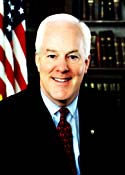 WASHINGTON—U.S. Sen. John Cornyn, a member of the Constitution, Civil
Rights and Property Rights subcommittee, introduced legislation Monday
in response to a controversial ruling by the United States Supreme Court
in Kelo v. City of New London. In a 5-4 decision, the Court held that
government may seize the home, small business, or other private property
of one owner and transfer that same property to another private owner,
simply by concluding that such a transfer would benefit the community
through increased economic development.
WASHINGTON—U.S. Sen. John Cornyn, a member of the Constitution, Civil
Rights and Property Rights subcommittee, introduced legislation Monday
in response to a controversial ruling by the United States Supreme Court
in Kelo v. City of New London. In a 5-4 decision, the Court held that
government may seize the home, small business, or other private property
of one owner and transfer that same property to another private owner,
simply by concluding that such a transfer would benefit the community
through increased economic development.
The Cornyn legislation would prohibit such transfers of private property, without the owner's consent, if federal funds were used, and if the transfer was for purposes of economic development rather than public use.
"It is appropriate for Congress to take action, consistent with its limited powers under the Constitution, to restore the vital protections of the Fifth Amendment and to protect homes, small businesses, and other private property rights against unreasonable government use of the power of eminent domain," Cornyn said.
"This legislation would declare Congress's view that the power of eminent domain should be exercised only 'for public use,' as guaranteed by the Fifth Amendment, and that this power to seize homes, small businesses, and other private property should be reserved only for true public uses. Most importantly, the power of eminent domain should not be used simply to further private economic development."
The legislation would clarify government's exercise of its power of eminent domain to be limited only for public use. 'Public use' shall not be construed to include economic development. This standard of protection would apply only to (1) all exercises of eminent domain power by the federal government, and (2) all exercises of eminent domain power by state and local government through the use of federal funds.
Sen. Cornyn currently chairs the Judiciary Committee's subcommittee on Immigration, Border Security and Citizenship, and in the last Congress he was chairman of the Constitution, Civil Rights and Property Rights subcommittee. He is the only former judge on the Judiciary Committee. Sen. Cornyn served previously as Texas Supreme Court Justice, Texas Attorney General, and Bexar County District Judge.
- Sen. Cornyn's floor statement Monday follows -
Mr. President, I rise today to introduce new legislation, entitled the Protection of Homes, Small Businesses, and Private Property Act of 2005. I introduce this legislation in response to a controversial ruling of the United States Supreme Court issued just last Thursday.
The protection of homes, small businesses, and other private property rights against government seizure and other unreasonable government interference is a fundamental principle and core commitment of our nation's Founders. As Thomas Jefferson famously wrote on April 6, 1816, the protection of such rights is "the first principle of association, 'the guarantee to every one of a free exercise of his industry, and the fruits acquired by it.'"
The Fifth Amendment of the United States Constitution specifically provides that "private property" shall not "be taken for public use without just compensation." The Fifth Amendment thus provides an essential guarantee of liberty against the abuse of the power of eminent domain, by permitting government to seize private property only "for public use."
On June 23, 2005, the U.S. Supreme Court issued its controversial 5-4 decision in Kelo v. City of New London. In that ruling, the Court acknowledged that "it has long been accepted that the sovereign may not take the property of A for the sole purpose of transferring it to another private party B," and that under the Fifth Amendment, the power of eminent domain may be used only "for public use."
Yet the Court nevertheless held, by a 5-4 vote, that government may seize the home, small business, or other private property of one owner, and transfer that same property to another private owner, simply by concluding that such a transfer would benefit the community through increased economic development.
This is an alarming decision. As the Houston Chronicle editorialized this past weekend: "It seems a bizarre anomaly. The government in China or Russia might take private property to hand over to wealthy developers to build shopping malls and office plazas, but it wouldn't happen in the United States. Yet, that is the practice the U.S. Supreme Court narrowly approved this week.
Local governments, the court ruled, may seize private homes and businesses so that other private entities can develop the land into enterprises that generate higher taxes." I ask unanimous consent that a copy of this editorial be included in the Record at the close of my remarks.
The Court's decision in Kelo is alarming because, as Justice O'Connor accurately noted in her dissenting opinion, joined by the Chief Justice and Justices Scalia and Thomas, the Court has "effectively . . . delete[d] the words 'for public use' from the Takings Clause of the Fifth Amendment" and thereby "refus[ed] to enforce properly the Federal Constitution."
Under the Court's decision in Kelo, Justice O'Connor warns, "[t]he specter of condemnation hangs over all property. Nothing is to prevent the State from replacing any Motel 6 with a Ritz-Carlton, any home with a shopping mall, or any farm with a factory." She further warns that, under Kelo, "[a]ny property may now be taken for the benefit of another private party," and "the fallout from this decision will not be random. The beneficiaries are likely to be those citizens with disproportionate influence and power in the political process, including large corporations and development firms.
As for the victims, the government now has license to transfer property from those with fewer resources to those with more. The Founders cannot have intended this perverse result."
Indeed, as an amicus brief filed by the National Association for the Advancement of Colored People, AARP, and other organizations noted, "[a]bsent a true public use requirement the takings power will be employed more frequently. The takings that result will disproportionately affect and harm the economically disadvantaged and, in particular, racial and ethnic minorities and the elderly."
In a way, the Kelo decision at least vindicates supporters of the nomination of Justice Janice Rogers Brown to the U.S. Court of Appeals for the D.C. Circuit. That nomination attracted substantial controversy in some quarters, because of Justice Brown's personal passion for the protection of private property rights. The Kelo decision announced last Thursday demonstrates that her concerns about excessive government interference with property rights is well-founded and well within the mainstream of American jurisprudence.
The Houston Chronicle has called upon lawmakers to take action, editorializing this past weekend that "lawmakers would do well to pass restrictions on this distasteful form of eminent domain." I firmly agree.
It is appropriate for Congress to take action, consistent with its limited powers under the Constitution, to restore the vital protections of the Fifth Amendment and to protect homes, small businesses, and other private property rights against unreasonable government use of the power of eminent domain.
That's why I am introducing today the Protection of Homes, Small Businesses, and Private Property Act of 2005. The legislation would declare Congress's view that the power of eminent domain should be exercised only "for public use," as guaranteed by the Fifth Amendment, and that this power to seize homes, small businesses, and other private property should be reserved only for true public uses.
Most importantly, the power of eminent domain should not be used simply to further private economic development. The Act would apply this standard to two areas of government action which are clearly within Congress's authority to regulate: (1) all exercises of eminent domain power by the federal government, and (2) all exercises of eminent domain power by state and local government through the use of federal funds.
It would likewise be appropriate for states to take action to voluntarily limit their own power of eminent domain. As the Court in Kelo noted, "nothing in our opinion precludes any State from placing further restrictions on its exercise of the takings power."
The protection of homes, small businesses, and other private property rights against government seizure and other unreasonable government interference is a fundamental principle and core commitment of our nation's Founders. The Kelo decision was a disappointment, but I want to congratulate the attorneys at the Institute for Justice for their exceptional legal work and for their devotion to liberty. We must not give up, and I know that the talented lawyers at the Institute for Justice have no intention of giving up.
In the aftermath of Kelo, we must take all necessary action to restore and strengthen the protections of the Fifth Amendment. I ask my colleagues to lend their support to this effort, by supporting the Protection of Homes, Small Businesses, and Private Property Act of 2005.
I yield the floor.
Government: Is a Credit Counseling Service Right for You August 21, 2004
Government: Human Trafficking in the United States: Rescuing Women and Children from Slavery July 18, 2004
Government: Break the Silence - Make the Call (Domestic Violence)
Government: Archive of previous government articles
© 2004-2006
League City Area News Online.
All rights reserved.
Marilyn Clark.
League City Area News Online, P. O. Box 1693, League City, Texas 77574-1693
Please include your address and phone number for verification purposes.