

|
(alphabetized) |
 Gardening
Gardening
Gardeners’ Dilemmas On Citrus, Leftover Insecticide
by Dr. William M. Johnson
Galveston County Extension Agent - Horticulture
May 25, 2005
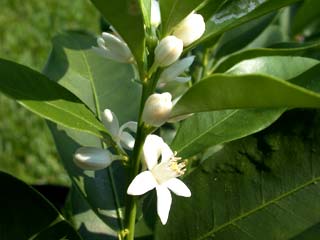 Citrus trees planted in the spring, such as the Meiwa kumquat shown above, may
produce an abundance of flowers during late spring and early summer. To remove—or
not to remove—any fruit set during the first season of growth to make the
tree stronger for future growth and production is a common dilemma. Photo
credit: William M. Johnson
Citrus trees planted in the spring, such as the Meiwa kumquat shown above, may
produce an abundance of flowers during late spring and early summer. To remove—or
not to remove—any fruit set during the first season of growth to make the
tree stronger for future growth and production is a common dilemma. Photo
credit: William M. Johnson
Question: How low should I have my St. Augustine grass cut? My lawn maintenance crewman keeps cutting it at about 1 1/2 inches tall. And the grass doesn't seem to be filling in and growing well.
Answer: One and one-half inches is the minimum height recommended for St. Augustine grass. Strong healthy grass requires leaves that produce carbohydrates from sunlight, carbon dioxide and water. When too much of the leaf surface is removed, the plant's ability to nourish itself, and grow a good root system and more leaves, is reduced. Maintaining a St. Augustine lawn at higher heights enhances its ability to withstand periods of extended dry weather during our hot summers.
Your St. Augustine grass should be cut at about 3 to 4 inches which is about as high as most lawn mowers can be set. Regardless of the mowing height, mow frequently enough (with a sharp blade) so you never cut off more than one-third of the grass blades in a single mowing.
Question: My orange tree has been producing good fruit for several years. However, last fall some of the fruits were very sour while some of the fruits were quite sweet. What caused this?
Answer: It appears that a branch has sprouted from the rootstock located below the graft. The rootstock is probably trifoliate orange and the fruits produced from this rootstock are extremely sour, almost bitter. Try to follow this branch downward and find out where it is attached to the tree trunk.
You will probably find that it is growing out of the trunk below the graft near the soil. Suckers growing from rootstock are very vigorous and will outgrow the rest of the tree in a couple years. Prune out this branch now.
Question: I have a Meiwa kumquat tree that I planted this spring and it is now producing an abundance of flowers. I was told by a friend to remove any fruit that set during the first season of growth to make the tree stronger for the future. Is this correct?
Answer: Technically, the advice you received was sound. You will indeed increase future growth and fruit production by removing any fruit that may set. And a commercial grower with acres of year-old citrus trees would be well advised to thin out or eliminate all fruit the first year.
But let's face it. We usually buy plants to enjoy. And with citrus much of the enjoyment comes from harvesting the first fruit from our own trees. While your Meiwa kumquat may set a large number of flowers, the actual fruit set is likely to be low during its first year of growth. Allowing a few fruits to mature to satisfy your curiosity and taste buds is understandable.
The amount of reduction in future growth and production is relatively minor, especially if the tree is provided proper care, including adequate watering and fertilization. And for one or two trees in your back yard, the reduction in production in future years would barely be noticeable. Enjoy your fruit tree.
Question: Now that Diazinon has been banned, what should I do with the bottle of Diazinon I have in my garage?
Answer: The best way to dispose of any registered pesticide is to use it on the landscape according to the label instructions. So continue to use it according to the directions on the container on your vegetables, fruits, trees, and shrubs until the Diazinon is used up.
Question: My tomatoes have suddenly developed several cracks on the stem end of the fruits. What is causing this to happen?
Answer: We are several inches below our normal rainfall at this time and thus have had extended periods of dry weather conditions over the last few weeks. When rainfall occurs to our area (as in the rainstorm a couple of weeks ago), the sudden increase in soil moisture is causing tomato fruit to develop cracks open as it begins to expand.
The fruit cracking is caused by too little water followed by an abundance of water. In the future during dry periods, try to keep the soil around tomato plants irrigated on a regular basis to maintain uniform soil moisture conditions. Then when we get heavy rains, your tomatoes will be less likely to crack or split.
Question: My citrus tree has black material on the upper surface of some of the leaves? I was told this is a fungus. Can I use a fungicide on it?
Answer: You have sooty mold, a fungus that grows on the sweet residue (known as honeydew) left from sucking insects such as aphids and citrus whitefly. So don't use a fungicide. That will not get to the cause of the problem. You need to use something to control the insects. Try using one of the horticultural oil sprays such as Ultra Fine Pesticidal Oil or Green Light Neem Oil. You may have to make two or more applications about 7 to 10 days apart. Be sure to also apply either product to the lower side of all the leaves. Read and follow the manufacturer’s directions for use including conditions of air temperatures.
The horticultural oil suffocates the insects and greatly reduces their population
while not harming most beneficial insects that also feed on the aphids and whiteflies.
The horticultural oil will also help loosen the sooty mold. Then rainfall and
normal weathering will gradually cause the sooty mold to disappear.
Dr. Johnson is a horticulturist with the Galveston County
Extension Office of Texas Cooperative Extension, Texas A&M University.
Visit his web site at http://aggie-horticulture.tamu.edu/galveston/index.htm
Gardening: Scale insects and pampas grass - July 17, 2004 article
Gardening: Bananas - August 1, 2004 article
Gardening: August Gardening Calendar - August 16, 2004 article
Gardening: Prepare Now For Fall Gardens - August 26, 2004 article
Gardening: September’s Garden Calendar Includes Fall Pecan Field Day - September 2, 2004 article
Gardening: Ornamental Grasses - September 8, 2004 article
Gardening: Don't Let Landscape Become A High-Maintenance Nightmare - September 22, 2004 article
Gardening: Rose Propagation & Seasonal Decorating Workshops To Be Held - October 13, 2004 article
Gardening: November Is Pansy Time - November 6, 2004 article
Gardening: County Pecan Growers Display Their Successes - November 11, 2004 article
Gardening: Gardeners' Questions On Fall Crops - November 17, 2004 article
Gardening: Gardeners’ Q&As For November - November 28, 2004 article
Gardening: Gardeners' December Checklist Includes Citrus Show On Dec. 9 - December 3, 2004 article
Gardening: Citrus Show A Huge Success With 185 Entries - December 19, 2004 article
Gardening: Trees and Shrubs - December 23, 2004 article
Gardening: Cold Weather Impact - January 4, 2005 article
Gardening:Announcing the 2005 Galveston County Master Gardener Training - January 13, 2005 article
Gardening:Peach & Plum Growers' Workshop To Be Held Saturday, January 29 - January 19, 2005 article
Gardening: Gardening for Texas Wildlife - January 28, 2005 article
Gardening: Extension Activities At The Home & Garden Show On Feb. 26-27 - February 23, 2005 article
Gardening: March Gardening Calendar Includes Seminar On Butterfly Gardening - March 2, 2005 article
Gardening: Gardeners' Q&As From The Galveston Home & Garden Show - March 10, 2005 article
Gardening: Program On Plumeria Offered On March 26- March 29, 2005 article
Gardening: Garden Checklist For April Includes Pecan Field Day - April 6, 2005 article
Gardening: Hints On Harvesting Vegetables For Peak Flavor - April 15, 2005 article
Gardening: Learn About Weed Control - April 27, 2005 article
Gardening:Home Gardening Chores and
May 14 Home Fruit Growers’ Tour - May 5, 2005 article
Gardening: Apples To Home Fruit Growers’ Tour - May 12, 2005 article
© 2004-2006
League City Area News Online.
All rights reserved.
Marilyn Clark.
League City Area News Online, P. O. Box 1693, League City, Texas 77574-1693
Please include your address and phone number for verification purposes.