

|
(alphabetized) |
 Government
Government
Cornyn calls for immediate repeal of death tax
Says unfair tax hurts Texas farmers, ranchers and family-owned businesses; Senate vote expected Thursday morning
From the Office of Senator John Cornyn
June 15, 2006
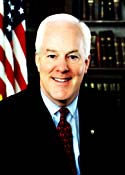 WASHINGTON—U.S.
Sen. John Cornyn (R-Texas), a member of the Small Business, Budget and Joint
Economic Committees, on June 7 called for an immediate repeal to the death
tax. The Senate is currently debating The Death Tax Repeal Permanency bill,
H.R. 8, with a vote on whether to proceed to final passage expected Thursday
morning.
WASHINGTON—U.S.
Sen. John Cornyn (R-Texas), a member of the Small Business, Budget and Joint
Economic Committees, on June 7 called for an immediate repeal to the death
tax. The Senate is currently debating The Death Tax Repeal Permanency bill,
H.R. 8, with a vote on whether to proceed to final passage expected Thursday
morning.
Sen. Cornyn delivered the following remarks on the Senate floor:
Excerpts:
“There are those who say this is just to benefit the rich and wealthy. That ignores the reality on the ground. The death tax brings the hammer down on Texas farmers and ranchers whose most valuable asset is their land. To pay this double tax, farmers and ranchers are threatened with the prospect of selling just to pay their tax.
“Not only does the death tax discourage small businesses and farmers and ranchers from saving, it also hinders their ability to operate from generation to generation. The current death tax burden especially makes it progressively more difficult for each succeeding generation to keep an agricultural operation going. The death tax reduces the inheritance available to heirs, again discouraging people from working, saving, and investing.
“Dying should not be a further burdensome, expensive, and complicated event because of the death tax. Right now, it is.
“Because of the President’s leadership and the leadership of this Congress in passing important tax relief, we were able to put money back in the pockets of ordinary Americans so that they could then invest and help grow the economy that has benefited us all. Let us not get in the way of that important progress by failing to take the necessary action to end the death tax once and for all.”
Full text:
I congratulate Senator Kyl, who has been a true champion of this effort and a leader on a bipartisan basis, for his good work. I know we were delayed a little bit because we thought we were going to come to the floor with this important legislation about the time that Mother Nature sent us Hurricanes Katrina and Rita. But we are back here through no small effort on the part of Senator Kyl. I thank him for his leadership. This is an issue which affects my constituents in Texas a lot and concerns Americans, as we know, across a broad political spectrum, as a result of public opinion polls. It goes back to 2001, when Congress passed the Economic Growth and Tax Relief Reconciliation Act which included a phase-out of the death tax. Eliminating the death tax was an important part of that overall tax relief package which has played no small part in the incredible economic expansion we have seen in America since that time: two million new payroll jobs in the past year; more than five million new payroll jobs since May of 2003; unemployment is at 4.6 percent, the lowest in almost 5 years; home ownership has reached all time highs, including among those categories of minority owners who traditionally have lagged behind in terms of their pursuit of the American dream. The economic growth and expansion we are seeing today would not have been possible but for the important tax relief this Congress passed with President Bush’s leadership in 2001 and 2003.
Unfortunately, because of our budget rules, because of our inability to get 60 votes for permanent repeal, Congress has been unable to completely eliminate the death tax. The death tax will amazingly disappear in 2010 but then rear its ugly head in 2011 and revert to its pre-2001 level. In other words, unless we act, the American taxpayer will see a huge tax increase.
This debate is about whether members of the Senate truly believe that death should remain a taxable event for American taxpayers, especially those who are hit in a disproportionately disadvantageous way -- ranchers, farmers, and small business owners. I favor eliminating the death tax because, fundamentally, it is an unfair tax. Once you earn income and pay taxes on your income, then Uncle Sam comes along, when your loved one is lying on their deathbed, and says: We want another bite out of your savings and assets that have accumulated due to your hard work and industry.
There are those who say this is just to benefit the rich and wealthy. That ignores the reality on the ground. The death tax brings the hammer down on Texas farmers and ranchers whose most valuable asset is their land. To pay this double tax, farmers and ranchers are threatened with the prospect of selling just to pay their tax. This is true of small business owners who have chosen perhaps not to incorporate or form a business organization such that they can take advantage of other tax exclusions and exemptions but, rather, this affects small business owners in a disproportionately negative way as well. The death tax discourages savings. By taxing bequests, the death tax discourages small business owners and family farms from saving and reinvesting in their business. Many economists bemoan the fact that Americans don’t save enough compared to other countries. Eliminating the death tax would lower the barrier to savings that so many Americans face.
Not only does the death tax discourage small businesses and farmers and ranchers from saving, it also hinders their ability to operate from generation to generation. The current death tax burden especially makes it progressively more difficult for each succeeding generation to keep an agricultural operation going. The death tax reduces the inheritance available to heirs, again discouraging people from working, saving, and investing. We are all familiar with the stories of sons and daughters having to sell the family farm their parents gave them so they could merely pay the tax bill upon the demise of their loved one.
The death tax also discourages entrepreneurial activity, which is the key to keeping America competitive in the global economy. As ironic as it may seem, the former Soviet Union, our opponent in the Cold War, understands the positive economic benefits of eliminating the death tax. Last year, Russia eliminated its own death tax. In fact, 414 Members of the Duma, the Russian Parliament’s lower house, voted in favor of the proposal, a record at the time.
Dying should not be a further burdensome, expensive, and complicated event because of the death tax. Right now, it is. IRS data indicates that more than half of the estates of those who die in America are required to file a death tax return even though they never owe any death tax to begin with. In addition, complying with one or more of the complicated parts of the Internal Revenue Code can be crushing when you consider that taxpayers need to hire attorneys and accountants, appraisers, and other experts to make sure that all their t’s are crossed and their i’s are dotted. Many taxpayers are not lucky enough to afford the armies of accountants and tax lawyers needed to avoid the death tax through the use of legal and reasonable trusts or foundations. The IRS interacts with American taxpayers every day in one way or another. It should not be there on the day those taxpayers leave this Earth.
I know there are concerns expressed by some colleagues with regard to the budget deficit. There is no doubt that Congress needs to do all it can to responsibly control the rate at which we spend on mandatory programs which are the primary cause of our deficit, growing as they are at the rate of eight percent or more a year -- Medicare, Social Security, and Medicaid. Earlier this year, I offered an amendment to the budget resolution that would have built on the successes of the Deficit Reduction Act and further reduced the growth in mandatory spending. Unfortunately, it was not accepted.
Some advocate keeping the death tax in the IRS Code as the key to opening the door of fiscal discipline. I disagree. Following this path will lead to nowhere and lead there fast. What it will do, instead, is slam the door on ranchers and farmers and family-owned businesses. That is not something I am prepared to do. To ensure the economy’s continued momentum, we need to make sure the permanent elimination of the death tax is included in this legislation. We have to end the death tax once and for all as a matter of fundamental fairness.
The fact is, by cutting taxes, we spur economic activity, which, in part, accounts for why the budget deficit is actually lower than had been projected earlier, because the revenue to the American Treasury has increased with the burst and expansion of economic activity. With more people working, more people paying taxes, there is more revenue into the Treasury. We have been through a recession, national emergencies, corporate scandals, and a war. Yet because of the President’s leadership and the leadership of this Congress in passing important tax relief, we were able to put money back in the pockets of ordinary Americans so that they could then invest and help grow the economy that has benefited us all. Let us not get in the way of that important progress by failing to take the necessary action to end the death tax once and for all.
© 2004-2006
League City Area News Online.
All rights reserved.
Marilyn Clark.
League City Area News Online, P. O. Box 1693, League City, Texas 77574-1693
Please include your address and phone number for verification purposes.